How to Split a PE Class into Teams Without Embarrassing Anyone
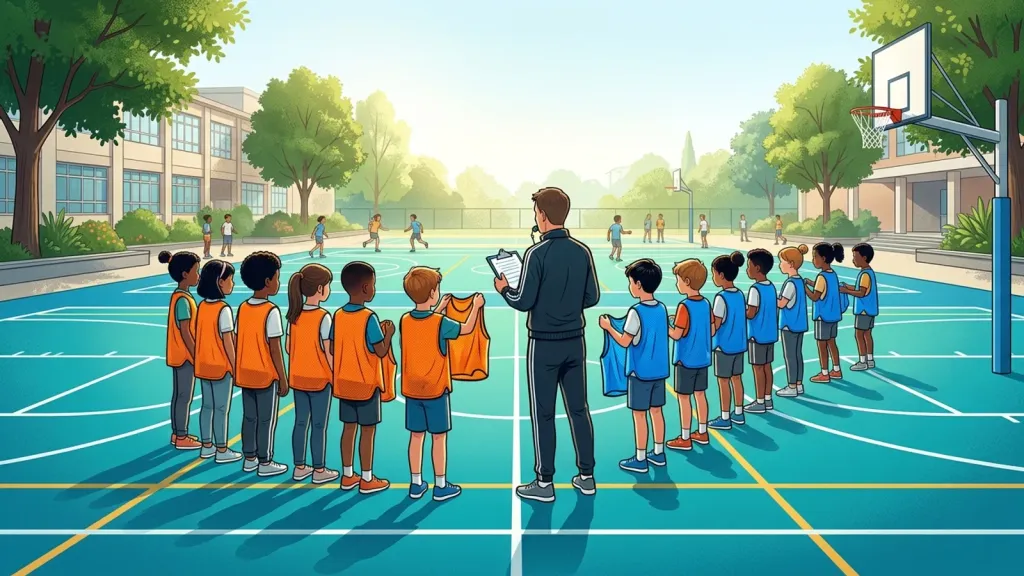
The fastest fix is to stop using team captains who pick students one by one. There are at least five ways to split a class into teams in under two minutes that don’t single anyone out, and depending on the method, still produce teams that are technically balanced. None of them relies on two students pointing at classmates in front of the whole group.
Why picking captains is the wrong method
Team captains solve a real problem: two students who know the class’s skill level can build fairly even teams. The cost is that someone is always the last name called, in front of everyone, week after week — usually the same two or three students.
SHAPE America (formerly NASPE in the United States) lists captains picking teams among the instructional practices to avoid, exactly because of this effect. That’s not pedagogical exaggeration; it’s the reason to change the method.
5 methods that split a class in under two minutes
1. Numbered counting off
Students line up (as they already do for attendance) and count aloud, alternating numbers: “one, two, one, two…” to the end. Everyone who said “one” forms a team, everyone who said “two” forms the other — or “one, two, three, four” if the activity needs more groups.
- Time: about 30 seconds.
- Teaching effect: zero individual exposure. The split depends on the order students were already standing in, not on a choice made on the spot.
- Best age group: any age, from elementary to high school. It’s the best option at the start of the school year, when the teacher doesn’t yet know the class’s skill level.
2. Colored token or object draw
A bag with colored tokens, sticks, or small balls — one color per team — is passed around, and each student pulls one without looking. The color drawn defines the group.
- Time: 1 to 2 minutes, depending on class size.
- Teaching effect: visual and playful. Works well with children who aren’t yet fluent with numbers, and the “pull from the bag” mechanic feels like a game, not a selection.
- Best age group: early childhood and elementary, generally up to age 10.
3. Attendance list split ahead of time
The teacher builds the teams at home from the attendance list, alternating names to balance skill level based on what they’ve already observed in previous classes. In the gym, they just read the finished list out loud.
- Time: zero during class (the work happens beforehand); reading it out takes about a minute.
- Teaching effect: the only method on this list that delivers real skill balance without exposing the process — students see the result, never the choice happening.
- Best age group: classes the teacher already knows, generally from upper elementary onward, when games become more competitive and balance matters more.
4. Digital draw projected on screen
The teacher types the class list into a team randomizer and projects the result on the board or a phone screen. The split comes out ready in seconds, already with the number of teams set. If you already have the student list ready and want to split it without any debate, the team randomizer does this automatically, even when the number of students doesn’t divide evenly between groups.
- Time: under a minute.
- Teaching effect: full transparency — the whole class sees the same process at the same time, which removes any accusation of favoritism.
- Best age group: any age, and especially useful for large classes or teachers who run several classes a day and need to move fast.
5. Matching card pairs
Cards with two halves of an image — half a ball, half an animal, a color and its matching symbol — are handed out randomly. Each student has to find whoever holds the other half, and the pairs (or the groups indicated by the completed card) become the teams.
- Time: about 2 minutes.
- Teaching effect: turns the split itself into an icebreaker. It’s the best option when the class doesn’t know each other well yet, since it forces students to interact before the game even starts.
- Best age group: elementary and middle school, ideal for the start of the school year or with new classes.
Side-by-side comparison
| Method | Time | Skill balance | Best age group |
|---|---|---|---|
| Numbered counting off | ~30s | Random | Any age |
| Colored tokens | 1–2 min | Random | Early childhood, elementary |
| List split ahead of time | 1 min in class | High (hidden) | Upper elementary, high school |
| Digital draw | <1 min | Random | Any age, large classes |
| Matching cards | ~2 min | Random | Elementary, middle school, start of year |
No random method guarantees skill balance — only the pre-split list does that, because it depends on what the teacher has already observed. That’s not a flaw in the other four: when the goal is to start playing fast without embarrassing anyone, random is exactly the point.
When skill balance matters more than speed
For interclass tournaments or classes focused on a specific sport, it’s worth combining methods: use the team randomizer or the pre-split list to separate students by level and, within each level, draw randomly for who plays with whom — the same logic described in the comparison of team draw methods. If the class has a number that doesn’t divide evenly between teams, the guide on how to split teams with an odd number of players covers the options — rotating substitute, a wildcard player, or one team with an extra person. For larger classes, the math on how many teams to form and what size is detailed in how to split 20 people into teams.
Frequently asked questions
Can I use more than one method in the same class? Yes. It’s common to use numbered counting off for warm-ups and a digital draw or pre-split list for the main game, when balance matters more.
How do I balance skill level without repeating the captains problem? Prepare the split before class, based on what you’ve already observed, and just announce the finished result. Balance happens, but no one watches the choice being made in public.
Do these methods work for sports other than soccer? Yes. None of them depends on the sport — they work equally well for volleyball, handball, dodgeball, or any activity that needs to split the class into groups.
The class has an odd number of students, what do I do? You can form one trio alongside a team, use one student as a wildcard who switches sides each round, or have that student referee that match. The guide on splitting teams with an odd number of players covers each option in detail.