Team Drafting Methods: Odds/Evens, Captains, Drawing Names, and Random Shuffle
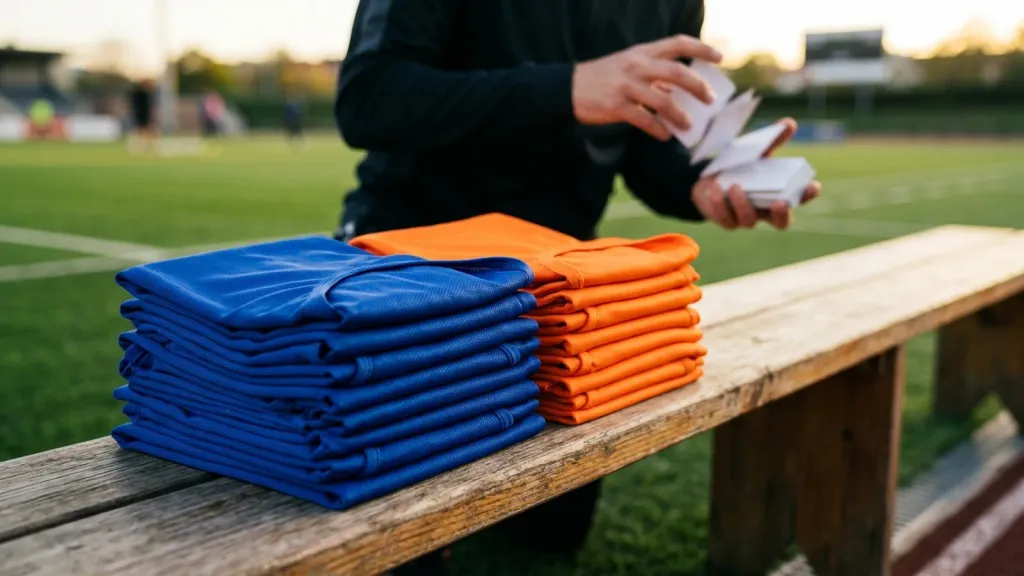
None of these six methods is technically “wrong” — each one solves part of the problem and ignores another. Odds/evens is fast but hands power to two people. Captain-style drafting tends to produce more balanced teams, but it humiliates whoever gets picked last. Drawing names from a hat is impartial, but it can stack the five best players on the same side by pure chance. There’s no perfect method — there’s the right method for your group, and that’s what this article helps you decide.
The problem is social before it’s technical
When a pickup game turns into an argument, it’s rarely about the draft result. It’s about how it was done. A team that ends up unbalanced by luck gets shrugged off — “bad luck today.” A team that ends up unbalanced because the captain picked his friends first triggers a complaint on the spot.
Three things matter in a drafting method, and they compete with each other:
- Speed — how much time the group loses deciding teams instead of playing.
- Perceived fairness — whether the process looks impartial to the people it affects, even when the result is good.
- Real balance — whether the two teams actually end up similar in skill level.
None of the methods below wins on all three fronts at once. Picking one means deciding which of the three you’re willing to sacrifice.
The six methods, one by one
1. Odds or evens (rock-paper-scissors style)
Two people — usually the first to show up or the loudest in the group — play odds/evens, and the winner chooses first, either picking a specific player or forming their team. It’s the fastest method on this list, but it concentrates the decision in just two people. In small, relaxed groups it works fine because nobody minds; in groups with a history of tension, it turns into two bosses picking their allies.
2. Captain-style draft
Two captains — elected, drawn at random, or simply the “owners” of the pickup game — take turns picking one player at a time until the group runs out. It’s the method that comes closest to real balance, because whoever is picking has information about each player’s level. The downside is the side effect: someone is always the last one picked, in front of everyone. In adult groups that have known each other for years, that becomes a running joke. In groups with kids, teens, or newcomers, it’s the fastest way to make someone not come back the following week.
3. Drawing names from a hat
Names on slips of paper, folded and pulled from a cap or bag. Nobody chooses anything — chance decides. It’s the most impartial method in terms of process: there’s no captain, no favoritism, and no one can complain about who ended up with whom. The downside is that it completely ignores skill level. It’s entirely possible — and it happens often — that the five weakest players in the group all end up on the same side.
4. Digital random shuffle
The modern version of drawing names: a list of players gets shuffled by a website, app, or spreadsheet, and the result comes out ready. It has the same impartiality as drawing names — nobody chooses, nobody can be accused of favoring a friend — just faster, without needing paper, a pen, or a cap on hand. The limitation is the same: random doesn’t mean balanced. If the group already has its final player list and wants to split it without debate, the team randomizer does that division automatically, even when the headcount doesn’t split evenly.
5. Elimination count-off (for larger groups)
An extension of odds/evens for when more than two people are deciding: the group counts off at the same time, and whoever ends up alone or in the minority is eliminated, until two people remain to set the picking order. In practice, it works as a more democratic way to decide who the captains will be, but it still ends up in captain-style drafting — with the same balance advantage and the same downside of exposing whoever gets picked last.
6. Skill-tier draft with randomness inside each tier
A hybrid method: the group first ranks players by skill level (as described in the guide to balancing soccer teams), then shuffles randomly within each tier instead of letting two people pick manually. It’s the only method on this list that aims for real balance without relying on captains picking people in front of everyone. The cost is time: someone needs to rank the group before drafting, which doesn’t make sense for a one-off pickup game with players nobody has ever seen play.
Side-by-side comparison
| Method | Speed | Perceived fairness | Real balance |
|---|---|---|---|
| Odds or evens | Very high | Low | Low |
| Captain-style draft | Medium | Low | High |
| Drawing names | High | Very high | Low |
| Digital random shuffle | Very high | Very high | Low |
| Elimination count-off | High | Medium | High |
| Skill-tier draft with randomness | Low | High | High |
No row scores “high” on all three at once — if one did, it would be the only method anyone ever used.
Which method fits your group
- Casual group, no pressure on the result: drawing names or digital random shuffle. Nobody argues with a result chance decided, and the time cost is close to zero.
- Competitive group that plays the same lineup every week: skill-tier draft with randomness inside each tier. The extra time pays off because balance affects the quality of the game week after week.
- Groups with kids, teens, or newcomers: avoid captain-style drafting. The balance gain doesn’t outweigh the risk of someone feeling rejected in front of everyone.
- Group that already argues about the draft: take the decision out of people’s hands. A digital random shuffle removes any accusation of favoritism, because there’s no one doing the choosing.
Frequently asked questions
Are odds/evens and captain-style drafting the same thing? No. Odds/evens decides who picks first; captain-style drafting is the process of building the teams once the two captains are already set. In practice the two usually go together: odds/evens sets the captains, and alternating picks build the teams.
Is a random shuffle always fairer than captain-style drafting? More impartial in process, not necessarily in outcome. Captain-style drafting tends to produce teams closer in skill level, because whoever is picking has information. A random shuffle is blind to that — it can land fine or stack the best players on the same side by coincidence.
Can you combine methods? Yes, and the skill-tier draft with randomness is exactly that combination: it reduces the arbitrariness of captain-style picking without fully giving up on technical balance.