The Odd One Out: How to Split Teams When Players Don't Divide Evenly
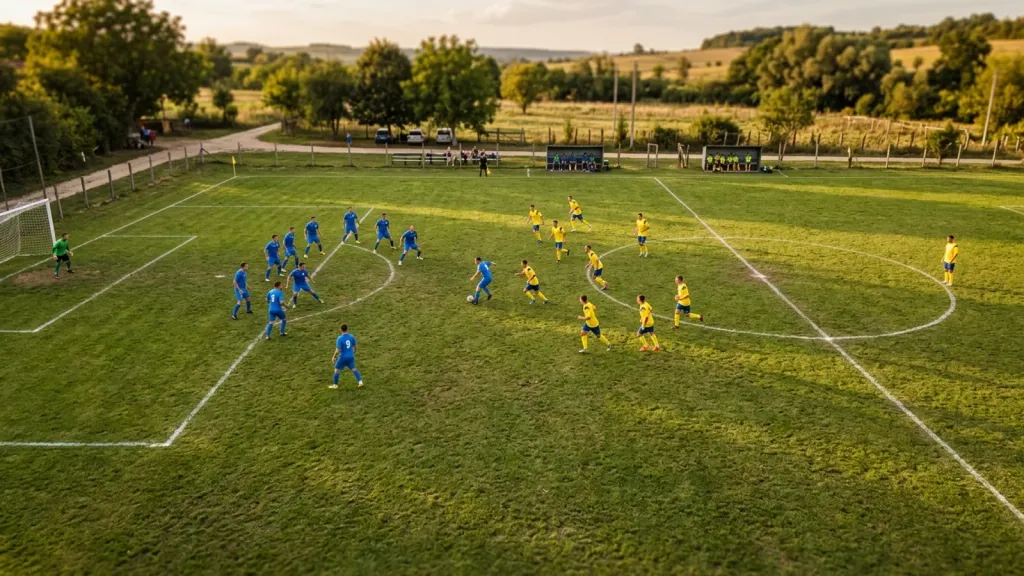
Thirteen people show up for Saturday’s pickup game and the list just won’t split into two even teams. Nobody has to sit out the whole match, and nobody has to accept a lopsided lineup either: you can play with an uneven team, run a floater who moves between both sides, share a goalkeeper, or set up a rotation that gets everyone in at some point. The right call depends on how many people are left over and what kind of game this is. Here are the five most common fixes, with the player count where each one works and the point where it breaks down.
Why the numbers never line up
RSVPs for pickup games are unstable right up to kickoff. Someone brings a friend last minute, someone else bails, and the regular goalkeeper sometimes counts as a player and sometimes doesn’t, depending on who’s counting. The result is a group that rarely lands on an exact multiple of two, and when it does, it’s usually luck rather than planning.
The problem gets more visible the smaller the teams are. In a 5-a-side game, one extra player is 10% of a full side sitting outside one of the teams. In an 11-a-side match on a full pitch, that same extra person barely registers. So the right fix also depends on the format: futsal and small-sided games feel the imbalance faster than full-field soccer.
The 5 ways to handle a leftover player
1. Uneven teams (the simplest fix)
One team plays with an extra player, no compensation at all. It’s the fastest solution because it doesn’t require explaining a new rule to anyone — everyone has played this way at some point.
It works well when only 1 player is left over and the group’s skill level is fairly even, since the smaller team makes up for it by covering more ground. It breaks down when 2 or more players are left over (the imbalance starts affecting the score) or when the extra player is clearly stronger than average — in that case, put the reinforcement on the team that would have been weaker after a random draw, not on the side that’s already favored.
2. The floater: the player who plays for both sides
One player has no fixed side. They attack with whichever team has the ball and help mark whoever’s defending, usually roaming the midfield without locking into a defensive role. In simpler versions, they only join the attacking phase for both teams and their goals don’t count — more of a “neutral support” role.
This works well in groups that already play together regularly, because the floater has to accept a role without a fixed claim on the win, and that takes people who play for the game more than for the scoreline. It breaks down when more than 1 player is left over (two floaters at once confuse things more than they fix) or when the floater ends up, in practice, only playing for one side.
3. Shared goalkeeper
The same goalkeeper defends both goals, switching sides on each attack, or simply stays fixed while the outfield players are split evenly on both sides.
This works great in 5-a-side futsal or small-sided games, when the leftover person happens to be the one willing to go in goal — in those formats the goalkeeper is already a separate role from the rest of the team, so “sharing” them solves the number problem without touching anyone’s attack. It breaks down on a full-size pitch, where the distance between the two goals makes it physically impossible for one keeper to cover both ends, and in games with frequent simultaneous attacks.
4. Rotation (loser-leaves or timed swaps)
Extra players don’t sit out entirely — they rotate in on a timer (a different player rests every 10 minutes, for example) or through a loser-leaves system, where the losing team hands its spot to whoever was waiting.
This works well when 3 or more players are left over and the group is patient enough to wait their turn, because it spreads the rest time fairly instead of always benching the same person. It breaks down in games with no natural pause (a single 90-minute half with no stoppage, for instance) or when there isn’t enough total playing time to cycle through everyone.
5. Handicap compensation
The smaller team gets an agreed advantage before kickoff: the bigger team needs to win by 2 goals, or the short-handed team’s goals count double for the first stretch of the game.
This works in competitive groups that value a fair contest over a simple rule set. It breaks down in casual groups, because every extra rule is a new thing to argue about mid-game — and nobody wants to stop a pickup match to debate whether a goal counted double.
| Method | Ideal leftover | Where it breaks |
|---|---|---|
| Uneven teams | 1 player | 2 or more leftover |
| Floater | 1 player | More than one floater at once |
| Shared goalkeeper | 1 player (the keeper) | Full pitch, simultaneous attacks |
| Rotation | 3 or more | Non-stop games with no pauses |
| Handicap | Any number | Casual groups, rule becomes an argument |
Which one to pick, based on how many are left over
- 11 or 13 players (1 leftover in a two-team split): uneven teams is the fastest route. If the group prefers to keep sides matching, the floater solves it without anyone admitting one side is short.
- 15 players: this is the magic number for three teams of 5. Instead of forcing two uneven sides, set up three full teams and run a loser-leaves rotation — each team rests a third of the time, and effectively nobody sits out, they just wait their turn.
- 7 or 9 players: with small groups, a 1-player gap (5v4 or 4v3) is usually the only workable option, since there aren’t enough people for a proper third team.
- 2 or more leftover in a two-team split: rotation, or forming a third team (even an incomplete one), works better than insisting on two uneven sides.
When a third team makes sense
Numbers divisible by 3 make this math easy: 15 becomes three teams of 5, 21 becomes three teams of 7. With full teams rotating, the loser-leaves system stops being “who sits out” and becomes “who’s resting now” — that changes how the group perceives the fix, even if the actual playing time per person ends up similar.
When the total doesn’t split evenly into three (13 or 14 players, for example), consider a smaller third team of 3 or 4 that only comes on when the opponent is also running short — this works better in timed games than in games played to a fixed number of goals.
If the group already has the player list ready and just wants the teams sorted fast, the team draw tool builds the sides automatically and, when the numbers don’t split evenly, randomly picks who sits on the bench — instead of always leaving the same person out by the organizer’s call. To balance by skill level once the numbers are sorted, the complete guide to balancing soccer teams covers the full method. And if this kind of headcount surprise happens every week, the guide to organizing the perfect pickup game covers the planning that avoids most of the chaos before you even count who showed up.
Frequently asked questions
Does the team with the extra player need to give up a position? It’s not required, but it helps: putting the extra player in a support role (midfield or attacking depth) instead of stacking the defense tends to keep the game more balanced than simply adding another defender.
Can the floater score goals? It depends on what the group agrees on. Many groups let the floater score for either side; others prefer they only help build the play without finishing, precisely so they don’t decide the result on their own.