How to Split 20 People into Teams: How Many Teams and What Size
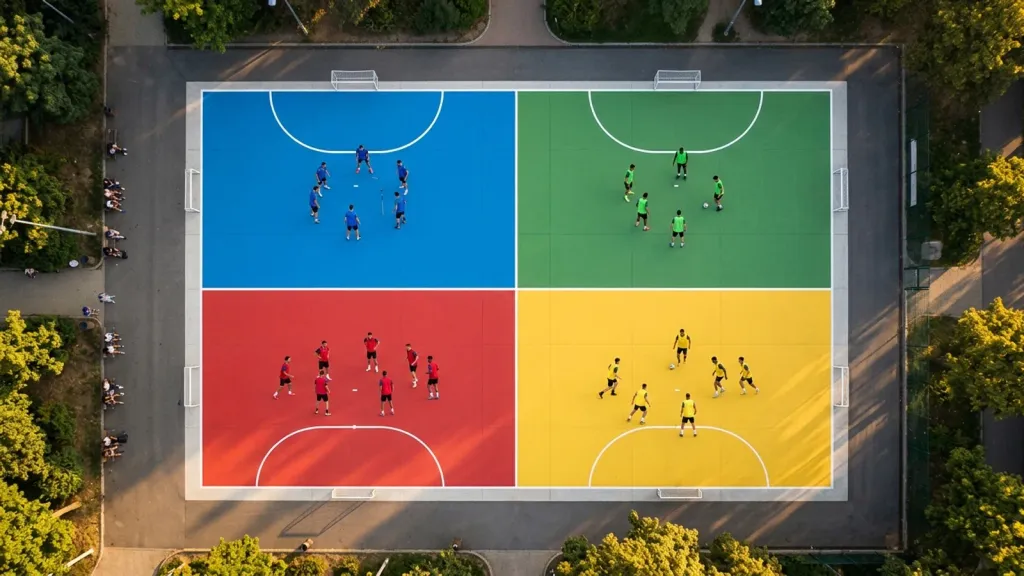
With 20 people, the splits that actually work are 2 teams of 10, 4 teams of 5, 5 teams of 4, or 2 teams of 7 starters with 6 people rotating off the bench. There’s no single right answer — it comes down to three things: how much space you have, how much time you’ve got, and whether everyone needs to play at once or can wait their turn.
The possible ways to split 20 people
| Split | People per team | Works best for |
|---|---|---|
| 2 teams of 10 | 10 + 10 | Futsal or volleyball with rotation, dodgeball, a large team-building session |
| 4 teams of 5 | 5 + 5 + 5 + 5 | 7-a-side reduced to 5, a quick mini-tournament with several short games |
| 5 teams of 4 | 4 + 4 + 4 + 4 + 4 | Fast round-robin, a station-based team-building event |
| 2 teams of 7 + 6 subs | 7 starters, 3 subs each side | 7-a-side (society) soccer with rotating substitutions |
| 3 teams of 6 + 2 subs | 6 + 6 + 6, 2 rotating | Volleyball “king of the court” format |
If you already know who’s playing and just need to sort them into teams, the team randomizer builds the rosters automatically from your list of names.
How to choose between the options
How much space you have. A single court only fits one game at a time — in that case, bigger teams with rotating subs (2x10 or 2x7+bench) keep people from standing around waiting for the next game to free up. Two courts or a large field let smaller teams play in parallel, like 4x5.
How much time you have. A tournament with several short games among 4 or 5 teams fits well into a two- or three-hour window, because each match is quick and everyone faces everyone. One longer game between 2 big teams is simpler to organize but leaves fewer people playing at any given moment.
Whether everyone needs to play at the same time. If the answer is yes — say, a corporate team-building day where nobody can sit out — split into small, simultaneous teams (4x5 or 5x4), each running a different activity. If rotation is fine, 2 large teams with a bench solves it with less logistics.
By sport
11-a-side soccer
An official soccer team has 11 players, including the goalkeeper — 20 people don’t fill two full teams (you’d need 22). In practice, groups of 20 running a pickup game usually scale the format down: two teams of 10 facing each other, or switching to 7-a-side.
7-a-side (society) soccer
7-a-side is played with 7 players per team, including the goalkeeper. With 20 people, the most balanced split is 2 teams of 10 — 7 starters and 3 subs on each side, rotating substitutions throughout the match. That keeps nobody standing still for too long while keeping the game close to the official format. The guide to balancing soccer teams helps split the 7 starters by skill level, not just by headcount.
Futsal
In futsal, each team takes the court with 5 players, one of them a goalkeeper. For 20 people, 4 teams of 5 lets you run a mini-tournament where each team plays the other three, with short knockout or round-robin games. If you’d rather have just one game running at a time, 2 teams of 10 with rotating starters also works well.
Volleyball
Official volleyball puts 6 players on court per team. With 20 people, the most common recreational format is 3 teams of 6, with 2 people rotating — the team that loses the set sits out, the next one steps in, “king of the court” style. You can also run 2 teams of 10 with frequent swaps, but since the official format calls for 6 at the net, keeping that number per team keeps the game closer to the real thing.
Dodgeball
Dodgeball doesn’t have a fixed team size set by any federation — it’s a recreational game, and the most common split is simply 2 teams of 10, each holding one half of the court. That works well for 20 people because it doesn’t depend on fixed positions or an exact number of players.
Corporate or family team-building
Without a court or a ball in the middle, the split stops depending on sport rules and depends only on the activities themselves. 4 teams of 5 tends to be the sweet spot for team-building: small enough that everyone actually participates, large enough to have people available for challenges that need different roles (someone carrying, someone solving, someone running). If the event has many quick, short rounds, 5 teams of 4 increases the number of possible matchups.
Frequently asked questions
Can you split 20 people into 3 equal teams? Not exactly — 20 divided by 3 is 6.67, so two teams would end up with 7 people and one with 6. That’s a fine split when there’s no better option (say, an activity that requires exactly 3 teams), but whenever the number divides evenly, go with 2, 4, or 5 teams instead.
What if some people can’t play the whole time? Favor splits with a fixed bench, like 2x7 with 3 subs each, instead of trying to fit everyone on the court at once. Rotating is easier than reshuffling the teams mid-game.
Is it worth making teams uneven on purpose? Only to offset a skill gap — putting one extra player on a team facing more experienced opponents, for example. Otherwise, equal-sized teams keep the game fairer and easier to explain. If the group is fixed and the pickup game repeats every week, the pickup game organizer’s guide covers the rest of the planning, from the attendance list to scheduling.