What Is a Play-In in Soccer? The Format Copa Paulista Adopted in 2026
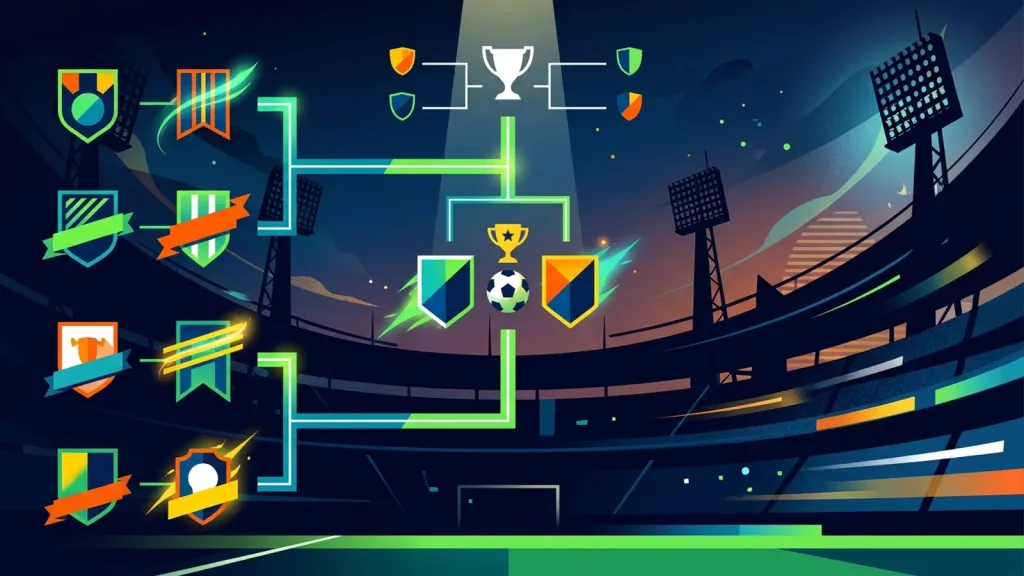
A play-in is an extra round wedged between the group stage and the main knockout bracket. Instead of sending home everyone who didn’t top their group, a play-in gives mid-table teams one more elimination match to fight for a knockout spot — while group leaders already have their spot locked in and just wait for an opponent.
The term comes from basketball, mainly the NBA, and has only recently started showing up in soccer. Copa Paulista, a competition run by the São Paulo state soccer federation for clubs outside the top-flight Campeonato Paulista, is one of the first concrete examples in Brazilian soccer: the 2026 edition introduced the format, and on August 22 the federation confirmed the eight clubs that would play it.
How the play-in works in Copa Paulista 2026
The competition has 16 clubs split into four groups of four, playing each other home and away within their group. After that first phase:
- the four group leaders move straight to the quarterfinals, skipping the play-in entirely;
- the runners-up and third-place teams from each group — eight clubs in total — drop into the play-in, a separate elimination round.
What sets this play-in apart from a simple “loser’s bracket” is the matchup rule: the eight play-in teams are re-ranked by their overall campaign across the whole tournament, not by their position inside their own group, and the pairings cross opposite ends of that range — 5th overall against 9th, 6th against 10th, 7th against 11th, and 8th against 12th. Points from the group stage don’t carry over into the play-in; every tie starts from zero, and it’s straight knockout from there.
Once the numbers were finalized on August 22, 2026, the first confirmed matchups were Primavera vs. Noroeste, São José vs. Osasco Sporting, União São João vs. Santo André, and Bandeirante vs. Grêmio Prudente — a good illustration of how overall campaign, not just the result inside the group, decides who plays whom.
The four play-in winners advance to the quarterfinals to join the four group leaders. From there, the seeding again looks at combined campaign: the leader with the best overall record faces the play-in winner with the weakest record among the four qualifiers, and so on down the bracket. If a tie survives regular time (aggregate score or single match, depending on the round), it goes straight to penalties, no extra time. The Copa Paulista 2026 champion also gets a concrete reward: a choice between a spot in Brazil’s 2027 Série D or the 2027 Copa do Brasil, with the runner-up taking whichever slot is left over.
Why use a play-in instead of going straight to knockout
A play-in solves a specific problem in group-stage tournaments: what to do with teams that finished “in the middle” — good enough to avoid instant elimination, but not good enough to top their group. Two common alternatives create distortion:
- Advancing only group leaders leaves out teams that, overall, had a better campaign than the leader of a weaker group.
- Automatically advancing every runner-up and third-place team, with no filter, rewards a strong campaign the same way it rewards a team that only qualified because it landed in a weak group.
A play-in fixes this by comparing mid-table teams against each other based on overall campaign, not their isolated position inside their own group. Only the teams that genuinely had the performance to stand out among the best “non-leaders” move on. At the same time, it preserves the reward for topping a group: an extra round of rest and, in theory, a more tired or weaker opponent.
How to adapt a play-in to your own tournament
You don’t need 16 teams to use this idea. The principle applies to any tournament with a group stage followed by a knockout bracket:
- Close out the groups normally, with round-robin points inside each group.
- Set the leaders apart. They move straight to the next round without playing the play-in.
- Rank everyone else together, comparing points, goal difference and tiebreakers across teams from different groups — not just their spot inside their own group.
- Cross the opposite ends of that range, best against worst down to the middle of the pack, the way Copa Paulista did with the 5th-to-12th band.
- Slot the play-in winners in against the leaders for the next round, pairing the best against the weakest to preserve the reward for topping a group.
Small example: a friends’ league with 12 teams in three groups of four. The three leaders advance straight to the semifinal. The remaining nine teams get ranked overall by campaign; the six best on that list (4th through 9th overall) play the play-in in three crossed matchups, and the three winners complete the semifinal bracket alongside the leaders. Teams ranked 10th through 12th overall are out.
This setup is worth it when your tournament has unevenly matched groups and you want to reward genuine campaign quality instead of the luck of landing in a weak group — but it takes more rounds and a well-kept overall standings table, so it works best in tournaments with enough matches to create a real points gap. If your league is short, a straight bracket or simple group stage is still more practical than adding an extra play-in round.
If you’re still at the stage of closing out the groups and just need to split participants into balanced squads, the Squadb team randomizer handles that automatically before you build the standings. And if you’re now wondering how many extra rounds this stage adds to the calendar, the how many games a tournament has breakdown by format helps estimate total tournament length once the play-in is included.
Frequently asked questions
Is a play-in the same as a repechage? Not quite. A repechage usually brings back teams that were already eliminated. A play-in happens before elimination is final: it decides, among teams still alive in the competition, who fills the remaining knockout-bracket spots.
Is the play-in a single match or two legs? In Copa Paulista 2026, play-in matchups are played home and away, with the aggregate score deciding the winner; a tie on aggregate goes to penalties.