How to Organize a Soccer Tournament With Friends: Formats, Brackets and Standings
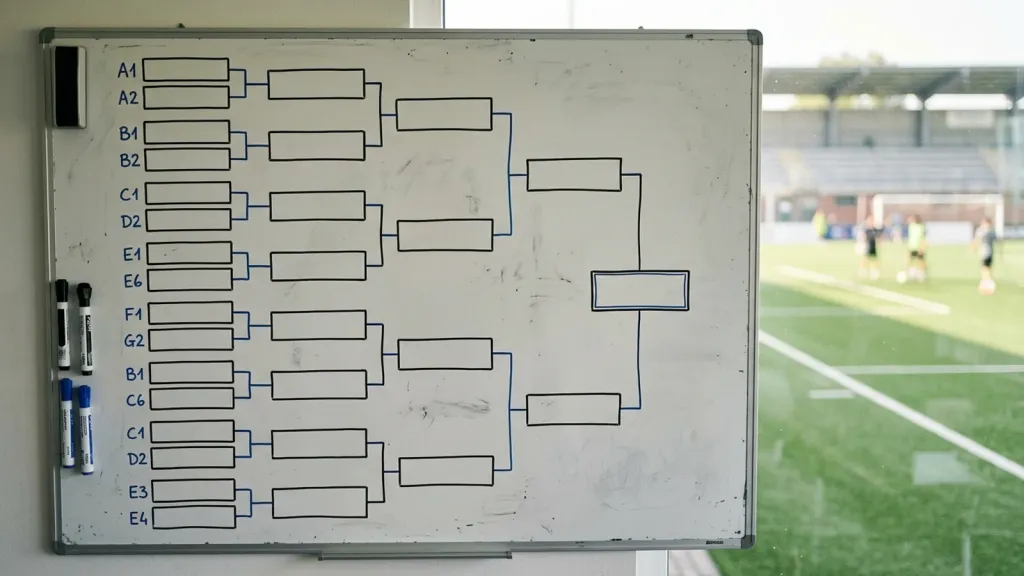
The decision that stalls most organizers is choosing between knockout, which wraps up fast but sends half the group home after a single loss, and round robin, which gives everyone plenty of games but doesn’t fit the afternoon on the rented field. The right call depends on three numbers you already have: how many teams, how much field time, and how many games each team needs to feel like showing up was worth it.
This guide walks through the three formats, how many matches each one produces, how much time that takes, and how to draw the bracket for 4, 6 and 8 teams.
The three formats, and when to use each
Knockout (single elimination). Every team plays until it loses once. It’s the fastest format, with the fewest possible matches, but whoever loses the first game goes home without playing again — the most common complaint from people organizing a tournament with friends. Works well with a large group (10+ teams) and limited field time.
Round robin (everyone plays everyone). Every team faces every other team once, points add up (win = 3, draw = 1, loss = 0), and the champion is whoever finishes with the most points. It guarantees the most games per team, but grows fast: with 8 teams that’s already 28 matches, unmanageable in one afternoon.
Groups + knockout. Split the teams into small groups of 3 or 4, play round robin inside each group, then send the top finishers into a final knockout bracket. This is the format most 6-to-12-team tournaments among friends end up choosing, because it guarantees a minimum number of games for everyone without blowing up the total tournament length.
| Format | Does everyone play more than once? | Grows fast with team count? | Best for |
|---|---|---|---|
| Knockout | No | No | Large groups, tight field time |
| Round robin | Yes | Yes | Up to 5 or 6 teams |
| Groups + knockout | Yes | Moderate | 6 to 12 teams |
How many matches each format produces
In round robin, the number of matches is n × (n − 1) ÷ 2, where n is the number of teams — every team meets every other team exactly once.
| Teams | Matches in round robin |
|---|---|
| 4 | 6 |
| 5 | 10 |
| 6 | 15 |
| 7 | 21 |
| 8 | 28 |
In knockout, the total is always n − 1, because every match eliminates exactly one team and there’s only one champion left at the end.
| Teams | Matches in knockout |
|---|---|
| 4 | 3 |
| 6 | 5 |
| 8 | 7 |
In groups + knockout, add up the group stage matches and the knockout matches. Example with 8 teams split into 2 groups of 4: each group plays round robin internally (4 × 3 ÷ 2 = 6 matches per group, 12 total), the top 2 from each group advance to the semifinals (2 matches) and the final (1 match). Total: 15 matches, and every team is guaranteed at least 3 games even if it doesn’t advance — that guarantee is exactly why the mixed format is the most common choice for a tournament with friends.
How much time that takes on the rented field
The math that decides the format is: total time = number of matches × (match length + turnover time).
Among groups of friends, the most common choice is running-clock matches of 10 to 15 minutes, with about 5 minutes of turnover between matches to swap bibs and set up the next matchup. That averages out to 20-25 minutes per match, turnover included.
A few examples with a field booked for 2 hours (120 minutes):
- 4 teams, knockout: 3 matches × 25 min = 75 min. Fits comfortably, with room left over for extra time or a third-place match.
- 4 teams, round robin: 6 matches × 25 min = 150 min. Doesn’t fit in 2h; you’d need 15-minute matches or more field time.
- 8 teams, groups + knockout: 15 matches × 25 min = 375 min (6h15). Only fits by splitting across 2 fields at once, shortening matches to 10 minutes, or spreading the tournament across 2 or 3 dates.
If the math doesn’t work out, it’s easier to shorten each match than to cut matches. Cutting matches removes exactly the guaranteed minimum-games benefit that makes the group format worth choosing.
Ready-made bracket for 4, 6 and 8 teams
4 teams (single knockout)
With only 4 teams, drawing the matchups at random works fine — there’s not enough prior ranking to justify seeding.
- Semifinal 1: Team A × Team B
- Semifinal 2: Team C × Team D
- Final: SF1 winner × SF2 winner
3 matches (4 with a third-place match between the semifinal losers).
6 teams (2 byes)
A knockout bracket always needs a number of slots that’s a power of 2 (4, 8, 16…). With 6 teams, the next power is 8, leaving 2 open slots — those 2 teams get a bye in the first round and go straight to the semifinal. If there’s no prior ranking, draw who gets the bye.
- Quarterfinal: Team C × Team F
- Quarterfinal: Team D × Team E
- Semifinal 1: Team A (bye) × winner of C×F
- Semifinal 2: Team B (bye) × winner of D×E
- Final: SF1 winner × SF2 winner
5 matches total.
8 teams (full bracket, no byes)
With 8 teams, nobody skips the first round.
- Quarterfinals: A×B, C×D, E×F, G×H
- Semifinal 1: winner of A×B × winner of C×D
- Semifinal 2: winner of E×F × winner of G×H
- Final: SF1 winner × SF2 winner
7 matches, 3 rounds.
Tiebreak criteria for the round robin stage
When two or more teams finish tied on points, decide the tiebreak order before the tournament starts, not after — it avoids arguments at the exact moment they matter most. The most common order, mirroring what many official leagues use, is:
- Goal difference (goals scored minus goals conceded)
- Goals scored
- Head-to-head result between the tied teams
- A draw, if the tie still isn’t broken
Write these criteria in the same place the group sees the standings, so nobody can claim the rule changed mid-tournament.
Building and sharing the standings
A simple spreadsheet handles any format. Google Sheets works well because it updates in real time for anyone with the link, with no need to resend a file after every round. The minimum columns are:
Team | P | W | D | L | GF | GA | GD | Pts
Update the results after each round and pin the link in the tournament chat group. If splitting players into teams is still pending, it’s worth handling that before locking the bracket — see how to balance soccer teams for a tighter tournament all the way to the last round. Anyone with just a list of players who needs to split them into squads fast can also use the Squadb team randomizer to handle it automatically before building the standings.
Frequently asked questions
Round robin or knockout for a small group? Up to 5 or 6 teams, round robin usually fits the available time and gives every team more games. Above that, the number of matches grows too fast and it’s worth switching to groups + knockout.
Can a round robin end in a tie for the title? Only if the tiebreak criteria (goal difference, goals scored, head-to-head) also tie between the top two teams — rare, but that’s exactly why it’s worth setting the tiebreak order before the tournament starts.
Do you need a third-place match? It’s not required. Most friend tournaments skip it and use the time to decide the champion — but if there’s field time left over, it’s one more guaranteed match for whoever’s already been eliminated.