How Many Games Does a Tournament Have? Math by Format and Time Needed
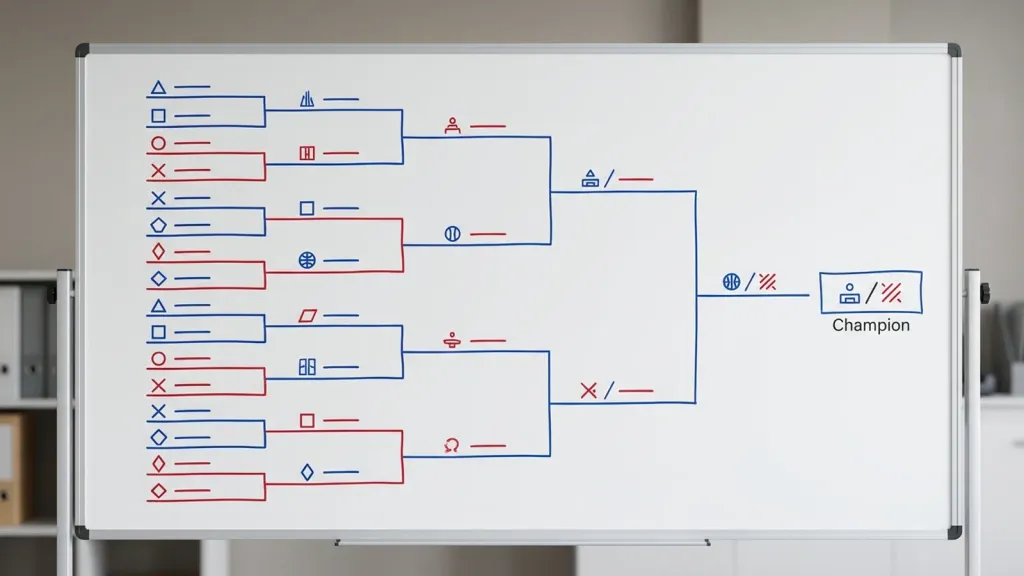
It depends on the format, but the math is simple. Round robin (everyone plays everyone once) generates n × (n − 1) ÷ 2 games, where n is the number of teams. Home-and-away doubles that total. Single elimination is always n − 1, no matter how many teams enter. Groups followed by a knockout stage adds the group-phase games to the knockout games. With 10 teams in a single round robin, for example, that’s already 45 matches — more than fits in one afternoon on a rented court, and that’s exactly the kind of math that should decide the format before registration closes.
The tables below answer it by team count, from 4 to 16, and then convert that total into court hours, so you know whether the format you picked fits the time you booked.
The formulas by format
- Round robin, single leg — n × (n − 1) ÷ 2. Every team faces every other team once.
- Round robin, home-and-away — n × (n − 1). Double the single-leg total, since every matchup repeats with venues swapped.
- Single elimination — n − 1. Every match eliminates exactly one team, leaving a single champion.
- Groups + knockout — the sum of each group’s internal games (round-robin formula applied to the group size) plus the knockout games among the teams that qualify.
How many games by number of teams
| Teams | Round robin (single leg) | Round robin (home-and-away) | Single elimination |
|---|---|---|---|
| 4 | 6 | 12 | 3 |
| 6 | 15 | 30 | 5 |
| 8 | 28 | 56 | 7 |
| 10 | 45 | 90 | 9 |
| 12 | 66 | 132 | 11 |
| 16 | 120 | 240 | 15 |
Notice the jump between round robin and single elimination: with 16 teams, single-leg round robin generates 120 games, eight times more than single elimination with the same group. That’s exactly why large leagues with many teams rarely run a pure round robin against everybody — the group stage format exists precisely to balance that math.
If your group has a team count that isn’t in the table, just apply the formula directly: a 14-team single round robin gives 14 × 13 ÷ 2 = 91 games.
Groups + knockout: how to run the math
Split the teams into groups, play round robin within each group, and advance the top finishers to a final knockout stage. The total is the sum of both phases — and group size changes the outcome quite a bit, even with the same number of teams entering.
| Teams | Group split | Group-phase games | Qualifiers | Knockout games | Total |
|---|---|---|---|---|---|
| 6 | 2 groups of 3 | 6 | 4 | 3 | 9 |
| 8 | 2 groups of 4 | 12 | 4 | 3 | 15 |
| 10 | 2 groups of 5 | 20 | 4 | 3 | 23 |
| 12 | 4 groups of 3 | 12 | 8 | 7 | 19 |
| 16 | 4 groups of 4 | 24 | 8 | 7 | 31 |
Notice that 12 teams split into 4 groups of 3 produces fewer games (19) than 10 teams in 2 groups of 5 (23) — smaller groups eliminate people earlier, so the total drops even with more teams entering the tournament. If guaranteeing games for everyone is the priority, bigger groups (4 or 5 teams) beat groups of 3. If finishing fast is the priority, groups of 3 shorten the opening phase.
One detail that trips up a lot of organizers: when the number of qualifiers for the knockout stage isn’t a power of 2 (4, 8, 16), someone gets a bye in the first round — but that doesn’t change the knockout’s total games, which is still qualifiers minus one. If you still need to lock down the bracket itself, our guide on organizing a soccer tournament with friends shows the full bracket, with matchups set, for 4, 6 and 8 teams.
Converting games into court time
The math that decides whether the format fits the time booked is:
Total time = (games ÷ courts running at once) × (match duration + break between matches)
Among amateur groups, it’s common to play 10-to-20-minute running-clock matches, with a 5-minute break to swap jerseys and set up the next matchup — an average of 15 to 25 minutes per game, break included. With that average, you can estimate how many games fit into a booked slot:
| Time booked | 1 court (20 min/game) | 2 courts at once (20 min/game) |
|---|---|---|
| 2 hours | 6 games | 12 games |
| 4 hours | 12 games | 24 games |
| 6 hours | 18 games | 36 games |
Cross-referencing with the table above: a 4-hour Sunday slot with a single court comfortably handles single elimination for up to 12 teams (11 games). A groups + knockout tournament with 8 teams (15 games), though, only fits in that same 4-hour window if games run faster than the 20-minute reference used above — at 15 minutes per game (225 minutes) there’s room to spare, but at 20 minutes per game it needs 5 hours, one hour more than what was booked. It can’t handle round robin with 8 teams or more — 28 games would need nearly 10 hours on one court, or two courts running all day.
If the math doesn’t fit, what to cut first
When the number of games doesn’t fit the available time, the adjustment order that best preserves the experience for players is:
- Shorten each match before cutting games — dropping from 20 to 12 or 15 minutes per match recovers a lot of time without pulling anyone off the court.
- Add a second court running at once, if space allows — doubles capacity without touching the format.
- Split the tournament across more than one date, especially the group phase, leaving only the final knockout for the decisive day.
- Change the format — from pure round robin to groups + knockout, or from home-and-away to single elimination — only as a last resort, since it changes the experience the most for anyone who only gets to play once.
Cutting games outright, without following this order, is usually the decision players notice and complain about most — the guarantee of minimum games is exactly what makes a format worth a full day booked. If teams still aren’t set, the Squadb team randomizer handles that split in seconds, before you apply any of the math above.
Frequently asked questions
How many games does a round robin have with an odd number of teams? The formula doesn’t change: with 7 teams, that’s 7 × 6 ÷ 2 = 21 games. Odd numbers only affect single elimination, where someone needs a bye in the first round.
Does home-and-away always double the number of games? Yes, because every single-leg matchup repeats a second time, usually with venues swapped. It’s the most complete format, but also the most expensive in time — it rarely fits a single one-day event.
Is it worth adding a third-place match to the count? If you’re including that match in the knockout stage, add one more game to the final-stage total — it’s not in the tables above because most friendly tournaments and small leagues skip that step.