Double Elimination Bracket: How the Upper, Lower Bracket and Bracket Reset Work
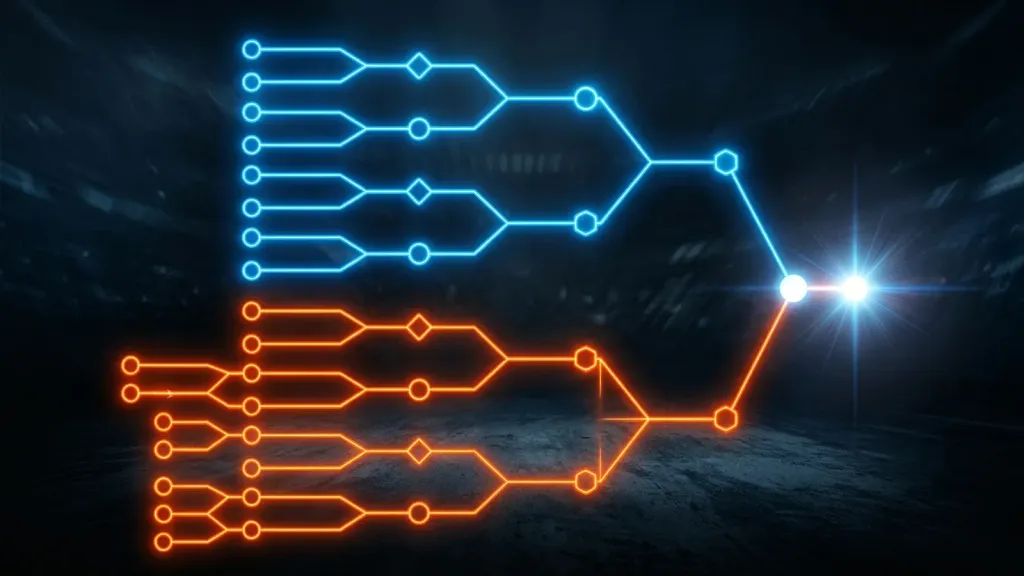
Losing one match doesn’t eliminate anyone — it just drops the team into the lower bracket. A team is only out once it loses twice. That’s the core difference from single elimination, where one bad result sends you home immediately. In double elimination, two brackets run in parallel: the upper bracket, for teams that haven’t lost yet, and the lower bracket, for teams playing with one loss already on the board, fighting to survive. The two only meet at the grand final.
It’s the format that decides the champion in nearly every major esports tournament — The International 2026 (Dota 2) is running its playoffs in Shanghai right now using exactly this structure, and the VCT Americas Stage 2 playoffs in Valorant, which crown their finalist in São Paulo in early September, follow the same model. Here’s the mechanic step by step.
Upper bracket: the single elimination format you already know
The upper bracket (also called the winners bracket) works exactly like a regular knockout. Every team starts here, plays direct elimination matchups, and winners advance. The difference is that losing here doesn’t eliminate you — it drops you into the lower bracket with one loss already recorded.
That makes the upper bracket the shortest possible path: with 8 teams, it takes 3 rounds (quarterfinals, semifinal and upper bracket final) for that bracket’s champion to lock a direct spot in the grand final, still with zero losses. If you just want that part — a plain 8-team single-elimination bracket, no lower bracket involved — the step-by-step lives in the 8-team bracket guide.
Lower bracket: where the second chance happens
The lower bracket is the part that confuses most people building their first bracket, because it doesn’t run in isolation — every round of the upper bracket sends newly eliminated teams “down” into it, mixing them with teams already fighting there. Every lower bracket match is a real elimination: lose, and you’re out of the tournament.
Here’s how that plays out in an 8-team bracket (A through H):
| Round | Upper bracket | Lower bracket |
|---|---|---|
| 1 | 4 matches: A-B, C-D, E-F, G-H (8 → 4 teams) | — |
| 2 | 2 matches, semifinal (4 → 2 teams) | 2 matches: the 4 round-1 losers face each other (4 → 2 survivors) |
| 3 | 1 match, upper bracket final (2 → 1, goes straight to the grand final) | 2 matches: the 2 lower bracket survivors face the 2 losers of the upper semifinal (4 → 2 survivors) |
| 4 | — | 1 match: the 2 survivors face each other (2 → 1) |
| 5 | — | 1 match, lower bracket final: that survivor faces the loser of the upper bracket final (2 → 1, advances to the grand final) |
Notice the pattern: whoever loses in the upper bracket always enters the lower bracket a round further along than teams already there, because they came in with one fewer match played. That’s why the two groups never mix in the same round without that offset — the system has to “wait” for the upper bracket to produce losers before slotting them in.
Grand final: why there’s sometimes an extra match (the bracket reset)
The grand final brings together two teams in an unequal position: the upper bracket champion arrives with zero losses, and the lower bracket champion arrives with one. If the tournament’s rule is that everyone needs two losses to be eliminated, a single grand final match isn’t enough to hold both sides to the same standard.
That’s where the bracket reset comes in: if the lower bracket team wins the first grand final match, both sides are now tied at one loss each — and a second, decisive match settles the real champion. If the upper bracket team wins outright, the tournament ends there, because they never picked up the second loss that would justify another game.
Not every event applies the reset. One example running right now: the VCT Americas Stage 2 2026 playoffs in Valorant, which also run double elimination with an 8-team bracket and crown their finalist in São Paulo in early September, skip the bracket reset — instead of a second match, the team arriving undefeated from the upper bracket gets a map ban advantage in the grand final as compensation for never losing. The The International 2026 playoffs (Dota 2), running in Shanghai during this same stretch, show the “standard” double elimination format in action: every match is best-of-three except the grand final, which is best-of-five between the upper bracket champion and the lower bracket survivor.
In other words: the bracket reset is the mathematically “pure” way to close a double elimination fairly, but some events skip it because of time — a second best-of-five series can mean another hour and a half of play, decided suddenly, with no broadcast slot reserved for it. If you’re running your own tournament, decide this before registration closes: with reset, it’s fairer; without it, it’s easier to schedule.
How many matches the bracket has and how many games each team plays
For a team count that’s a power of 2 (4, 8, 16, 32…), the math is direct: total matches fall between 2N − 2 (no bracket reset) and 2N − 1 (with bracket reset), where N is the number of teams.
| Teams | Matches without reset | Matches with reset |
|---|---|---|
| 4 | 6 | 7 |
| 8 | 14 | 15 |
| 16 | 30 | 31 |
| 32 | 62 | 63 |
That’s nearly double a single elimination bracket, which always lands at N − 1 matches — for the full comparison across formats, including round robin and groups, see the complete match count by format.
The number of games isn’t equal for everyone, though:
- Team eliminated in the first round: plays the minimum possible — loses in the upper bracket, drops to the lower bracket, loses again. For 8 teams, that’s 2 games.
- Champion coming straight from the upper bracket, never losing: plays one match per upper bracket round plus the grand final. For 8 teams, that’s 4 games, and no bracket reset is needed.
- Champion coming from the lower bracket, having lost once along the way and having to fight through the entire lower bracket: that’s the longest path in the whole bracket. For 8 teams, it can reach 7 games, counting the bracket reset.
That workload gap matters in practice: if your tournament depends on court time or people who need to get back to work, one team may end up playing three times as many matches as another on the same day. It’s worth weighing before picking this format for an event with a tight schedule.
When the team count isn’t a power of 2
Not every group divides neatly into 4, 8 or 16. With 6, 10 or 12 teams, the bracket needs byes: the best-seeded teams (by draw, prior ranking or group stage) advance straight to the upper bracket’s second round without playing the first. The logic is the same as single elimination — the bracket is built for the next power of 2 above the actual number of participants, and the leftover slots become byes distributed among the top seeds, so no one advances without playing more than one match in a row.
If you’ve already split participants into balanced teams and just need to build the bracket, Squadb’s team draw tool generates the knockout bracket automatically from the drawn teams — which handles the upper bracket on its own. The lower bracket, for double elimination, you build manually following the round logic explained above.
When double elimination beats single elimination
Single elimination is faster to run and easier to explain to participants, but it has a known flaw: a strong team can get knocked out in round one by a single off result, with no chance to prove they were better. That’s fine for a casual tournament among friends, where the goal is just to have a champion by the end of the afternoon — see how to build that kind of bracket, with match counts by format, in the guide to organizing a soccer tournament with friends.
Double elimination is worth the extra time and matches when:
- the tournament carries real competitive weight (a spot in another stage, a meaningful prize, an official ranking), and a single bad match shouldn’t decide everything;
- the team count allows fitting nearly double the matches within the time you have available;
- there’s enough structure to handle the uneven workload between teams that advance fast and teams that survive through the lower bracket.
If none of that applies to your case, single elimination gets the job done with half the organizing work.