Injured Player Off the Pitch for 1 Minute: The New Soccer Rule Explained
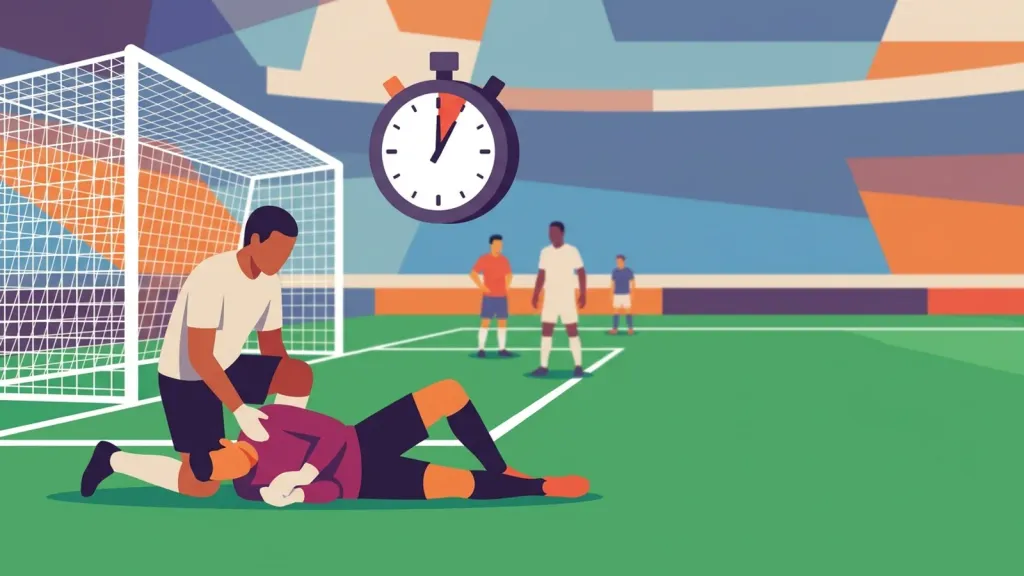
A player who receives on-pitch medical treatment now has to stay off the field for at least one minute after play resumes. The rule is in effect for Brazil’s 2026 Brasileirão season, approved by IFAB, the body that writes the laws of the game, with one clear goal: stop medical breaks from being used as a time-wasting trick.
The part that confuses most viewers is what happens when the treated player is the goalkeeper. He can’t simply sit out for a full minute — someone has to be in goal. Instead, an outfield player serves the penalty in his place, and the team plays temporarily a man down. That’s exactly what happened in the Internacional vs. Atlético-MG match on August 22, 2026, which became the first widely discussed example of the rule in action.
How the medical treatment rule works
Whenever the medical staff comes on to treat a player, three steps apply:
- The referee allows the medical team onto the pitch and play stops as usual.
- Once treated, the player must leave the field — he can only return after play has already restarted.
- He stays off for at least 60 seconds, counted from the restart, even if he feels ready sooner.
In practice, the team plays that minute a player short, because there’s no automatic substitution or immediate replacement — it’s a forced pause, not a permanent exit. Once the minute is up, the player returns to the pitch normally, without using up a substitution window.
The Brazilian federation (CBF) confirms the core rule: a treated player “must stay off the pitch for at least one minute” after the restart. IFAB’s stated intent is to reduce stoppages caused by players who simulate or exaggerate injuries to slow the game down — classic time-wasting.
There are exceptions for head injuries and more serious situations, where player safety takes priority over the rule’s clock.
What happens when the goalkeeper is the one treated
This is the part that trips up broadcasts. A goalkeeper can’t just leave the pitch for a minute — you can’t put another player in goal without making a substitution, and the team can’t be left with an empty net.
The solution adopted by the CBF: when the goalkeeper receives treatment, an outfield player serves the penalty instead. That player leaves temporarily, and the team plays with ten men for that same one minute, while the goalkeeper is already back between the posts as soon as treatment ends.
The coach decides which outfield player sits out, and the window to decide is short — according to reporting on the rule, the coaching staff has up to ten seconds to name the player. There’s no pre-arranged substitute; it’s a quick call, made on the spot, with the team already knowing it will be down a man for a few moments.
That’s why the play looks odd to viewers: the goalkeeper is standing up, apparently fine, and yet the team on the pitch is short-handed. It’s not a miscount or a missed card — it’s someone else serving the penalty for him.
The Everson case: the rule in practice
The first widely discussed case of the rule happened on August 22, 2026, in the match between Internacional and Atlético-MG, in round 24 of the Brasileirão, at the Beira-Rio stadium. In the second half, goalkeeper Everson went down after a collision with Internacional forward Vitinho and asked for medical attention.
Since the goalkeeper was the one treated, the penalty didn’t fall on him: forward Thiago Borbas was the player chosen by Atlético-MG’s coaching staff to leave the pitch, and the team played a full minute with ten men while Everson received treatment. The match ended 0-0.
The play was a good teaching moment because it combined both sides of the rule at once: why it exists (to stop medical treatment from being used as a stalling tactic) and its least intuitive mechanic (the goalkeeper gets treated, but another player pays the price).
The other anti-time-wasting rules in the 2026 Brasileirão
The medical treatment rule didn’t arrive alone. It’s part of an IFAB package the CBF began applying in the Brasileirão to cut unnecessary stoppages and increase actual playing time.
| Situation | Time limit | Penalty if not followed |
|---|---|---|
| Goalkeeper holding the ball | 8 seconds | Corner kick to the opponent |
| Throw-in | 5 seconds after picking up the ball | Throw-in awarded to the opponent |
| Goal kick | 5 seconds after the whistle | Corner kick to the opponent |
| Substituted player leaving the pitch | 10 seconds | Substitute only enters 1 minute later |
| Medical treatment | 1 minute off the pitch after restart | — (this is the penalty itself) |
The CBF’s stated goal is to raise the average ball-in-play time in the Brasileirão, currently around 52 minutes and 54 seconds per match, to the 60-minute mark set as FIFA’s target. The goalkeeper-holding-the-ball rule has its own quirks — see how long a goalkeeper can hold the ball.
Frequently asked questions
Does the rule apply to every CBF competition? The package of changes was announced for the Brasileirão starting in 2026, as part of the plan to roll out IFAB’s new laws across Brazilian football. FIFA-run international competitions had already been trialing similar rules before that.
Can a treated player be substituted instead of waiting out the minute? Yes. Nothing stops the coach from using the stoppage to make a normal substitution — in that case, the incoming player already fills the role, and the one-minute rule becomes irrelevant since the treated player isn’t coming back anyway.
What if treatment takes longer than a minute? The minute is a floor, not a ceiling. If the medical staff needs more time, the player stays off until he’s actually cleared — the rule’s clock only guarantees he can’t return before that.
An official refereeing rule isn’t something you can apply strictly at a weekend pickup game, of course, but the logic behind it — cutting out stalling and keeping the game flowing — is the same thing any group of friends debates when they organize the perfect pickup game.