How Many Seconds Can a Goalkeeper Hold the Ball? The 8-Second Rule and the Penalty
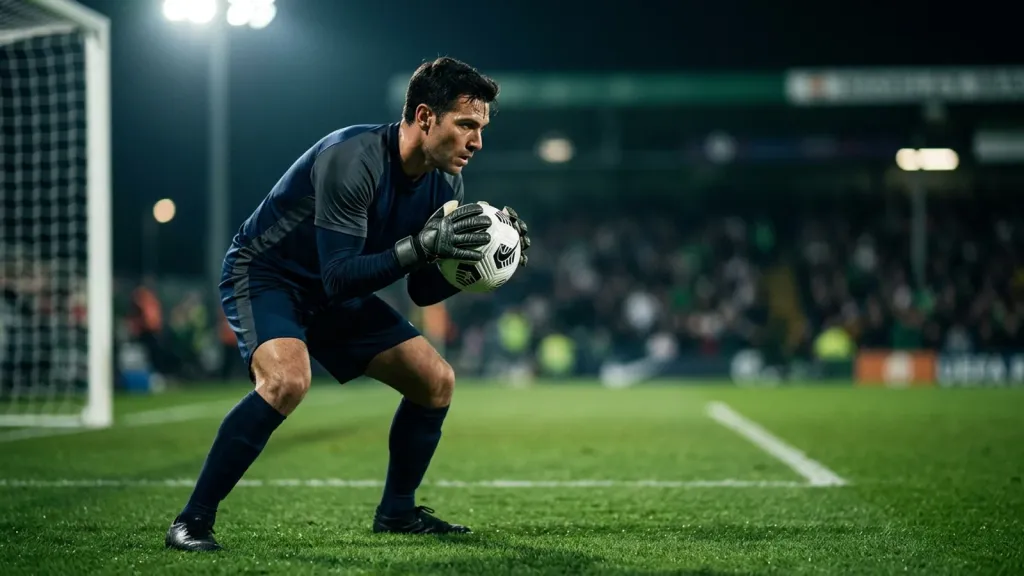
A goalkeeper can hold the ball with their hands for up to 8 seconds inside their own penalty area. Go over that, and the referee awards a corner kick to the other team — not an indirect free kick, which was the old punishment.
How the count works
The clock starts the moment the goalkeeper has clear control of the ball with their hands, inside their own box. During the last 5 seconds, the referee raises an arm and counts down visibly with their fingers, facing the goalkeeper, so everyone knows exactly how much time is left before the penalty kicks in.
If the goalkeeper releases the ball before the count ends — by kicking it, throwing it to a teammate, or dribbling past an opponent to play out from the back — the clock resets to zero. It only starts counting again if the goalkeeper picks the ball up with their hands once more.
What changed from the old rule
Through the 2024/25 season, the limit was 6 seconds, punished with an indirect free kick taken from inside the box. In practice, that rule was rarely enforced: an indirect free kick that close to goal is a huge risk for the defending team, so referees avoided calling a penalty they considered too harsh for the offense — and setting up the wall ate up time anyway.
| Old rule | Current rule | |
|---|---|---|
| Time limit | 6 seconds | 8 seconds |
| Punishment | Indirect free kick | Corner kick |
| Visible referee countdown | No | Yes, last 5 seconds |
The corner kick solved both problems: it’s a real punishment (a dangerous set piece for the attacking team) but not as disproportionate as an indirect free kick inside the six-yard box, so referees actually call it.
When the rule took effect
The change was approved by the International Football Association Board (IFAB), the official guardian of the Laws of the Game, as an amendment to Law 12.2. After trials in Premier League 2, Malta, and Italy showed positive results, the new count took effect worldwide on 1 July 2025, applying to every level of the game, from elite to amateur.
In Brazil, the CBF reinforced enforcement of the rule as part of a broader package of anti-time-wasting measures announced in August 2026, applying immediately to Série A, Série B, the Copa do Brasil, and the Brasileirão Feminino A1 — in Série A, starting from matchday 23. The guidelines follow the standard used at the 2026 World Cup, and the CBF estimates the full package can add roughly 6 minutes and 22 seconds of ball-in-play time per match.
The goalkeeper isn’t the only one on the clock
The 8-second rule is part of a wider package against deliberate time-wasting. The other measures include:
- Throw-ins and goal kicks: 5 seconds to take them, or possession switches to the other team.
- Substitutions: the player coming off has up to 10 seconds to leave the pitch.
- Medical attention: a player receiving treatment must stay off the field for at least 60 seconds, which discourages quick fake injuries just to burn time.
None of these measures change the number of players on the pitch or the length of the match — they all target what happens to the clock while the ball is stopped, which is exactly where “wasted time” hides.
Does it apply to a pickup game too?
The Law of the Game is the same for amateur football, but there’s no referee counting fingers and awarding corner kicks on an unofficiated five-a-side pitch. In practice, organized competitions with a referee and a match sheet feel the change first. If you’re the one organizing a pickup game and putting teams together before kickoff, check out the guide to organizing the perfect pickup game — the goalkeeper rule won’t change anything there, but how you organize the rest of the game makes far more difference on a Saturday afternoon than any stopwatch.
FAQ
Does this rule apply only to top leagues, or everywhere? It’s a Law of the Game set by IFAB, in effect worldwide since July 2025. The CBF simply reinforced enforcement alongside other measures specific to Brazilian football.
Can the goalkeeper pick the ball up again after releasing it? Yes. What resets the count is the moment they lose control of the ball with their hands — by kicking, throwing, or dribbling past an opponent. If they regain control afterward, the 8-second count starts over from zero.
Why replace the indirect free kick with a corner kick? Because the indirect free kick was almost never called in practice — referees saw it as disproportionate that close to goal, and setting the wall took time. A corner kick is a real punishment, but a proportionate one, which made the rule easier to actually enforce.
Another rules question that sparks arguments on the sideline is how many players are on a volleyball team — another case where the “right” number depends on whether the match is official or casual.