Pickup Game Rotation: Who Sits, Who Plays, and How to Rotate Teams When You Have Too Many Players
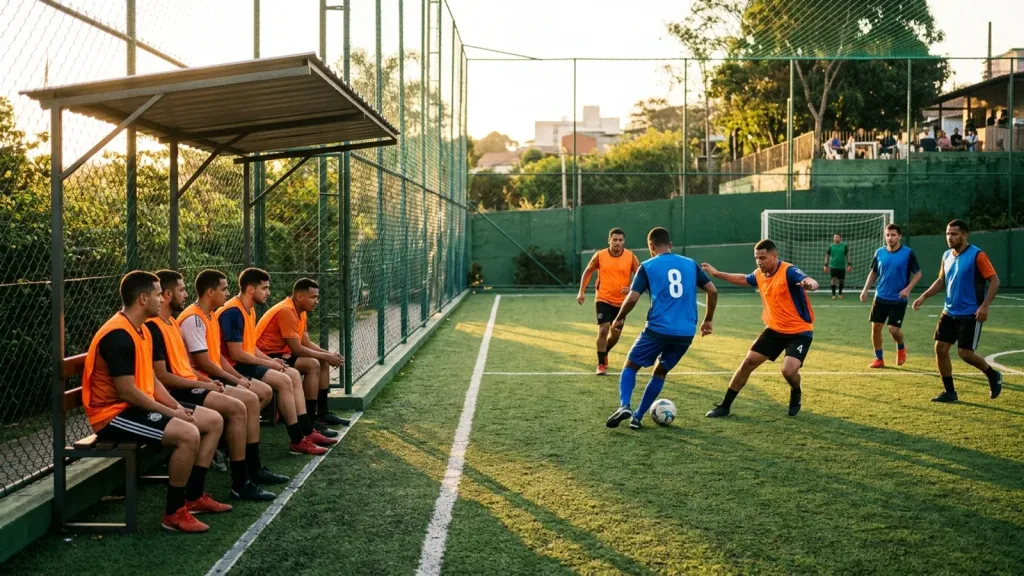
When 18 people show up and the pitch only fits 12, someone is sitting out — the only question is how long, and whether that split is fair or leaves the same four guys cooling off on the sideline all night. There are basically four ways to handle this, and each one costs a different amount of playing time for whoever isn’t on the strongest team.
The four rotation rules that show up in every pickup game
Winner stays, loser sits
The team that wins keeps playing; the team that loses gives way to whoever was waiting. It’s the most common rule and the easiest to explain, but it has a flaw: if one team is clearly stronger, it can dominate the pitch all night while the other two teams keep cycling in and out fast. This works fine when the teams are close in skill. It works badly when they aren’t — and that’s exactly where the “same team keeps playing” complaint comes from.
The whole team sits (with or without a win limit)
After every match, both teams on the pitch step off, even the winner, and the two waiting teams come in. A variation that’s also common in practice is to cap it: a team can win up to three matches in a row, but on the fourth it sits regardless of the result. This hybrid solves the “winner stays” problem without removing the reward of winning entirely.
Time-based rotation (the clock)
Ignores the score. Every fixed interval — 8, 10, or 12 minutes, depending on how much pitch time your group has — teams switch, no matter who’s ahead. It’s the easiest rule to enforce (someone with a phone just calls “time”) and the one that generates the least argument about who “really” won. The trade-off is that a team can get pulled off mid-streak, which bothers anyone who cares about the result.
Player-for-player substitution
Instead of whole teams swapping, one specific player from the sideline comes in for one specific player on the pitch — usually in an order agreed before kickoff, like a queue. This is common in smaller groups, games without fixed teams, or when a goalkeeper needs a break without pulling the whole team. It spreads playing time evenly across individuals, but it breaks the “team” logic — it doesn’t make sense if the pickup game is played as a contest between fixed squads for the night.
How much each player actually plays: the math
Take a common scenario: 18 people, three teams of six, a five-a-side pitch that only fits one match at a time, a two-hour session (120 minutes) of actual playing time.
With winner stays, no cap, if one team is clearly stronger and wins most matches, it isn’t unusual for it to hold the pitch for 90 of the 120 minutes, while the other two teams split the remaining 30 minutes coming in and out. In that scenario:
| Rule | Minutes for the strong team (per player) | Minutes for the other two teams (per player, average) |
|---|---|---|
| Winner stays, no cap | ~90 min | ~15 min |
| Winner stays, max 3 wins in a row | ~55 min | ~32 min |
| Whole team sits (every match) | 40 min | 40 min |
| Time-based rotation (fixed 10 min) | 40 min | 40 min |
The gap between the first and last row is six times more playing time for whoever is on the favorite team. That number — not the vague feeling of “we barely played” — is why the rotation rule matters as much as how you split the teams in the first place.
Which rule to pick for your group
- Group with fairly even skill across everyone — winner stays with no cap works fine, because no team will monopolize the pitch for long.
- Group with one clearly stronger team (usually because the same five or six people always play together) — use whole-team-sits, or the hybrid cap of three wins in a row. Without that, the game turns into the strong team’s training session against everyone else.
- Group that argues a lot about the score or the deciding goal — time-based rotation removes that argument entirely, since nobody sits “because of” a specific goal.
- Small group, no fixed teams, or a very social game — player-for-player substitution keeps everyone playing together longer, just swapping individual spots.
If the headcount doesn’t split evenly into same-size teams — 17, 19, 22 — the rotation rule alone won’t fix that; check how to split teams when players don’t divide evenly before deciding on the rotation, because a shorthanded team suffers twice: it plays less balanced, and it can also end up sitting sooner.
Ties and other situations that cause arguments
A tie is the most common source of confusion, because none of the four rules above settles what happens when a match ends level on its own. The most widely used practice: both tied teams step off, and the two waiting teams come in — the exception is when only one team is waiting, in which case the team that won the previous match stays and only the other one sits. Agree on this before the first kickoff, not in the middle of an argument.
It’s also worth deciding, before the first match, who calls the rotation — whether it’s someone’s phone timer, a fixed person in charge of the game, or the waiting team itself counting the clock. A rule with nobody to enforce it is just a suggestion, and a suggestion won’t get a team off the pitch that doesn’t want to leave.
Balance the teams before you start rotating
Rotation is only fair if the teams it starts from are already close in skill — rotating unbalanced teams just changes who’s losing, it doesn’t fix the problem. If you haven’t formed the night’s groups yet, check the complete guide to balancing soccer teams or use the team randomizer to split the squads automatically before applying any rotation rule.
Frequently asked questions
Does a team that loses by a big margin sit out faster? No, unless the group specifically agrees on that. In all four rules above, a 1-goal loss and a 5-goal loss end the same way — the result decides the match, not how fast the losing team leaves.
Can you combine time-based rotation with “whole team sits”? Yes, and it’s pretty common: the team sits when the clock runs out or when it loses before that, whichever comes first. This stops an early blowout from keeping the losing team on the pitch just because the clock hasn’t hit yet.
What if only one team is waiting, with nobody to sub in for the team resting? In that case the waiting team always comes in for whoever sits (winner or not, depending on the rule you chose), because there’s no third team to alternate with — the three-way rotation only works with at least three formed teams.