League of Legends roles: what top, jungle, mid, ADC and support actually do
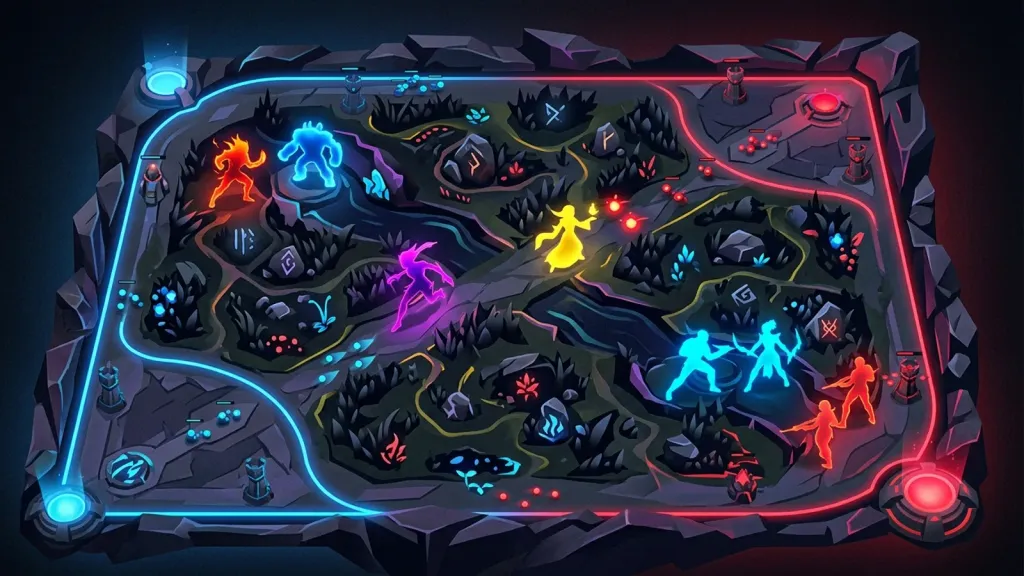
League of Legends is played five-a-side, and every player on the team fills one fixed role: top, jungle, mid, ADC and support. None of the five is optional — a team without a jungler doesn’t contest a single objective, and a team without a support loses its ADC early. The role determines where a player starts the match, what kind of champion they usually pick, and what their job is inside the team.
Why there are exactly five roles
The standard League map, Summoner’s Rift, has three lanes — top, mid and bottom — connecting the two bases, with a jungle area full of neutral monsters between them. Three lanes plus the jungle produce four obvious roles: top, mid, jungle and bottom lane. Bottom lane, though, is split between two players who start together — the marksman and the support — because it’s the only lane the game was designed to hold a duo from the start. That’s where the five classic roles come from, and it’s why the correct answer to “how many roles does LoL have” is never four or six.
Top: the one who plays isolated from the rest of the team
The top laner spends most of the early game essentially alone in the top lane, far from the rest of the team — players call it “the island” for exactly that reason. It’s the most self-sufficient role: if a top laner loses the lane, it’s usually their own mistake, not a lack of outside help. That’s why the role tends to favor tanks and bruisers, champions built to soak damage and win isolated trades. In the mid and late game, top becomes whoever opens the team fight or holds the front line while the rest of the team deals damage from behind, and it’s also the role most associated with split pushing — staying alone pushing top lane while the rest of the team fights elsewhere on the map.
Jungle: the one with no fixed lane
The jungler doesn’t sit in any of the three lanes. They farm neutral monsters in the jungle for gold and experience, and use that freedom to invade other lanes and help win duels — the well-known gank. They’re also the one who prioritizes the map’s neutral objectives: heralds, dragons and Baron Nashor, which grant team-wide advantages when killed. By controlling where and when those fights happen, the jungler has more influence over the game’s pace than any other role — they decide whether the game plays out fast and aggressive or slow and patient.
Mid: the one closest to everything
The middle lane is the shortest on the map and closest to the jungle on both sides, which makes the mid laner the role with the easiest access to leaving their own lane to help top or bot — the so-called roam. That’s why the role tends to favor mages or assassins, champions who clear minion waves fast enough to leave without losing territory. A well-played mid laner doesn’t stay glued to their own lane all game; they show up in fights elsewhere on the map and force the enemy team to play a man down somewhere.
ADC: the one who carries the late game
ADC — short for attack damage carry, also called marksman — is the role most dependent on items to function. Early in the match, the ADC is fragile and needs space to farm minions for gold; as items come online, they become the team’s biggest source of sustained damage in late-game fights. It’s the role most dependent on correct positioning: a well-positioned ADC deals damage the whole fight without being touched; an exposed ADC dies in seconds and takes the team out of the fight with them.
Support: the one who holds the rest of the team together
The support shares bottom lane with the ADC but farms very little on purpose — the gold from that lane is meant for the ADC. The support’s job is different: placing wards to reveal where the enemy team is, protecting the ADC from enemy dives, and starting or breaking up fights with their champion’s abilities. After the laning phase, the support tends to be the one moving around the map the most, warding objectives before they become available. It’s the role most decisive for players who understand the game and the most misunderstood by outsiders, because the kill count rarely shows the work it actually does.
The five roles, side by side
| Role | Where they play | Farm priority | Main focus |
|---|---|---|---|
| Top | Top lane, isolated | High | Holding the lane and opening or absorbing team fights |
| Jungle | Jungle, no fixed lane | High (on monsters) | Ganks and neutral objective control |
| Mid | Middle lane | High | Fast damage and support for other lanes |
| ADC | Bottom lane, with support | High | Sustained late-game damage |
| Support | Bottom lane, with the ADC | Low | Vision, protecting the ADC and engaging |
How to split the five roles among a group of friends without arguing
- Ask who already has a favorite role before drawing anything. Two or three usually sort themselves out — whoever always plays an assassin wants mid, whoever likes tanks wants top.
- Settle jungle and support first. These are the two roles that most often go unclaimed in friend groups, because they demand playing for the team instead of for your own kill count. If nobody volunteers, draw those two spots before the other three.
- Don’t put your least experienced player in the jungle. It’s the role with the most decisions per minute — which lane to gank, which objective to prioritize, which camp to farm — and it affects the whole team’s game, not just one lane.
- Rotate roles between matches, not mid-match. Switching roles in the middle of a practice session breaks each player’s read on their own lane.
- If the group is bigger than five and you still need to decide who plays on which team, Squadb’s team randomizer settles that split in seconds — then just apply the steps above inside each five-player team.
Frequently asked questions
Can you play more than one role? Yes, and most competitive players train at least two — usually a main and a secondary for whenever their main role gets picked by someone else first in queue.
Which role is easiest for beginners? Support tends to be the gentlest entry point: the champions demand less combat precision early on and teach map awareness and objective sense, which carries over to any other role later.
Is a jungler mandatory even in casual games? Yes. Without someone in the jungle, nobody contests neutral objectives and the team loses out on the gold and experience they provide — the gap shows up fast, even in a game with nothing on the line.
If your group also plays other competitive team games besides LoL, it’s worth comparing with how role splits work in Valorant: the same logic of “one role per person, so nobody fights over the same slot” applies there too.