How to build a Valorant team: roles, agent composition, and splitting duties
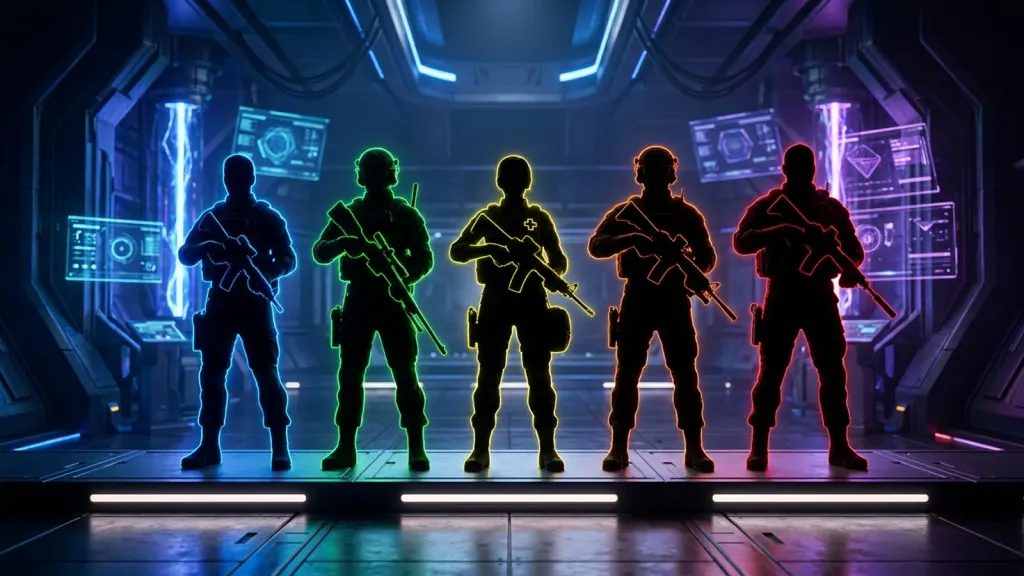
A Valorant team needs four roles covered: duelist, initiator, controller, and sentinel. With five players, that means one person locked into three of those roles and a fifth slot left flexible for whichever role the map or strategy needs more of. The most common mistake in a friend group isn’t skill — it’s everyone wanting duelist and nobody willing to hold controller or anchor a site.
The four roles, and what each one actually does
Every agent in Valorant belongs to a role, and the role describes the job inside a round — not how strong the agent is on paper.
Duelist: the one who opens space
The duelist enters the bombsite first, forces the duel, and creates the opening for the rest of the team to push through. Jett, Raze, Reyna, Phoenix, Neon, Yoru, Iso, and Waylay are examples of this role. It’s the most popular pick in a friend group — everyone wants the frag — but a team with three duelists and no controller loses the round before it even leaves spawn, because nobody’s covering the choke point with smoke.
Initiator: the one who opens information
The initiator uses a flash, drone, or recon dart to reveal where the enemy is before the engagement happens. Sova, Fade, Skye, Breach, Gekko, KAY/O, and Tejo fill this role. Without an initiator, the duelist walks in blind and the team trades in the dark.
Controller: the one who closes lines of sight
The controller drops smoke to cut angles, split the map, and let the team execute a site without getting picked off from a distance. Brimstone, Omen, Viper, Astra, Harbor, Clove, and Miks are the controllers. It’s the role most avoided in casual groups — and exactly the one that decides the most rounds at a competitive level.
Sentinel: the one who holds the position
The sentinel plants traps, heals the team, or locks down an angle, and is usually the one holding a site alone while the rest of the team attacks elsewhere — or watching the flank from the back. Killjoy, Cypher, Sage, Chamber, Deadlock, Vyse, and Veto fill this role. A team without a sentinel tends to lose rounds to flanks, even after winning the main engagement.
How many of each role fit a five-stack
There’s no mandatory composition, but the baseline that works on most maps is: one of each role locked in, with the fifth player reinforcing whichever one makes the most sense.
| Role | Recommended minimum | When to double up |
|---|---|---|
| Duelist | 1 | Large maps or a team that wants to play fast — 2 duelists |
| Initiator | 1 | Maps with a lot of blind angles — 2 initiators |
| Controller | 1 | Rarely doubled; one well-played controller already covers most maps |
| Sentinel | 1 | Maps with two sites far apart — 2 sentinels |
Common competitive compositions: 2 duelists / 1 controller / 1 initiator / 1 sentinel, or 1 duelist / 1 controller / 2 initiators / 1 sentinel. What almost never shows up — and almost always loses — is a team with zero controllers or zero sentinels.
Splitting roles with your friends, step by step
- Ask who already has a favorite agent. Half the split solves itself: whoever always plays Jett becomes the duelist, whoever always plays Killjoy becomes the sentinel.
- Lock in the controller before anything else. It’s the role that’s missing most often and the one that costs the most rounds when it’s missing. If nobody volunteers, draw for that slot first or rotate it match to match.
- Don’t stack two beginners in the support roles. Controller and initiator demand map reading more than raw aim — put your most tactical player there, even if they’re not your best shot.
- Keep the fifth slot flexible for the map of the day. Instead of fixing five roles permanently, let the fifth player float: extra duelist on an open map, extra initiator on a tight one.
- Rotate roles between matches, not mid-map. Swapping agents in the middle of a scrim session breaks the team’s read on the map. Adjust between matches, not during one.
If you’ve already split a larger group into two five-stacks and just need to decide who’s on which team, the Squadb team randomizer handles that split automatically — from there, distribute roles inside each team with the steps above.
When you’re short a player for all four roles
Groups of four, or a group missing one regular, don’t need to drop a role — they need an agent that covers two at once. A few examples: KAY/O plays as an initiator with duelist-level presence; Fade combines information with early pressure; Sage gives sentinel healing while also holding a corridor alone. In these cases, prioritize covering controller and initiator before doubling up on duelist — those are the roles that stall a team the most when missing.
Common composition mistakes
- Three duelists, zero controller. The team pushes fast and dies fast, because there’s no smoke to cut the lines of fire.
- Swapping agents every round. Losing the map control an agent already built — Killjoy’s setup, Fade’s intel — costs more than the variety is worth.
- Putting the newest player on controller just because “someone had to.” Controller demands constant timing decisions; it’s better held by whoever reads the map best, not whoever’s left over.
- Skipping the sentinel because “offense is the best defense.” That holds up until the team takes two straight rounds through the same flank.
Frequently asked questions
Do you need exactly one agent per role? It’s not a rule, but it’s the safest starting point. Adjust from there based on the map and your group’s playstyle.
Can you play without a sentinel? You can, but the team is exposed to flanks. It only really works on small maps where two people can cover both rotations.
Which role is easiest for a beginner? Initiator tends to be the gentlest entry point: the abilities help the team even before the player’s aim is sharp.