How to Draw Tournament Groups: Pots, Seeds and Draw Rules Explained
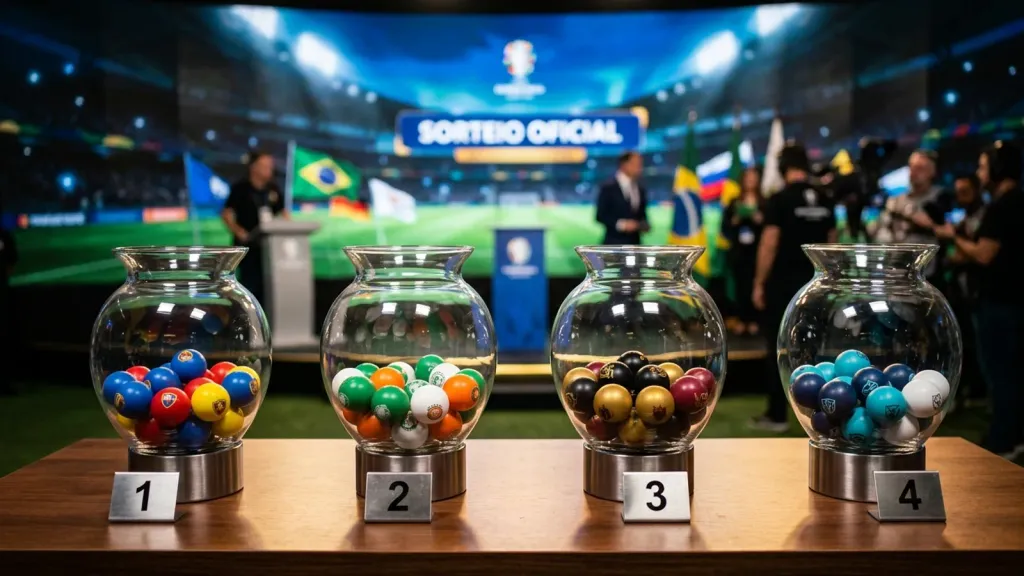
Dumping every team’s name into a single bowl and pulling them out one by one is the fastest way to ruin a tournament before the first kickoff. The three strongest teams can land in the same group, while another group ends up with no real competition at all. The fix is the same one the World Cup and Copa Libertadores use: split the teams into pots by strength before the draw, so every group gets exactly one team from each level.
What pots and seeds actually mean
A pot is a group of teams of similar strength. If your tournament will have groups of 4, you build 4 pots, each contributing one team to every group. The pot-1 team that lands in Group A is the seed — the strongest team in that group, usually ranked by last season’s results, an informal standings table, or a criterion everyone agreed on before the draw.
The core rule is simple: every group gets exactly one team from each pot. That’s what stops the draw from stacking all the favorites in one group and leaving the other side with nothing interesting to play for.
Why this changes the whole tournament
Without pots, a draw with 12 teams split into 3 groups of 4 has a real chance of putting the 3 or 4 best teams together in a single group — and that group basically decides half the title before the tournament is halfway done. Meanwhile, weaker teams pushed together play a group stage with no drama, because the outcome is more or less settled in advance.
With pots, every group is born balanced: one favorite, one mid-table team from each tier, and the race for qualification stays open until the last round in every group at once — which is exactly what makes a group stage worth watching.
How the World Cup and Libertadores actually do it
Worth looking at the big tournaments, because the mechanic is identical — only the scale changes.
For the 2026 World Cup, with 48 teams in 12 groups of 4, FIFA split the field into 4 pots of 12 teams each, ranked by the FIFA ranking. Pot 1 held the hosts — Mexico, Canada and the United States, pre-fixed into positions A1, B1 and D1 — plus the nine highest-ranked teams. On top of the pot system, extra restrictions apply: teams from the same confederation can’t land in the same group (except UEFA teams, since Europe has so many slots that each group can hold up to two, never three).
In the Copa Libertadores, CONMEBOL does the same with 4 pots of 8 clubs: pot 1 is drawn first and fills position 1 in every group, pot 2 fills position 2, and so on. The extra rule there is geographic: clubs from the same country can’t land in the same group, with an exception for teams that came through the pre-Libertadores qualifying stage.
The Champions League changed format in recent seasons — there’s no fixed group stage anymore, and the draw now assigns each club two opponents from each pot, eight in total, inside a single table. The principle of separating by pot is still the same; only the way it’s applied changed because the competition’s format changed.
Step by step: drawing groups for your own tournament
For a rec league, company tournament or amateur competition, the same logic scales down cleanly.
1. Decide the number of groups and their size
With 12 teams, the most common split is 3 groups of 4 or 4 groups of 3. The number of pots always equals the number of teams per group — if a group has 4 teams, you need 4 pots.
2. Rank the teams before building the pots
Use a criterion the organizing committee and the participants accept as fair: standings from the previous edition, results from recent friendlies, or a simple vote among team captains. The key is to fix the criterion before anyone knows who would land in which pot — if you build the pots after seeing the result, the draw loses its credibility.
3. Split into pots by strength tier
With 12 ranked teams (1st to 12th) and 3 groups, Pot 1 takes teams ranked 1st–3rd (the favorites, one per group), Pot 2 takes 4th–6th, Pot 3 takes 7th–9th, and Pot 4 takes 10th–12th.
| Pot | Teams (by rank) | Role in the group |
|---|---|---|
| Pot 1 | 1st–3rd | Seed |
| Pot 2 | 4th–6th | Second seed |
| Pot 3 | 7th–9th | Third seed |
| Pot 4 | 10th–12th | Fourth seed |
4. Apply restrictions, if they make sense
If two teams are from the same neighborhood, the same company, or train together every week, consider blocking them from landing in the same group — it’s the amateur equivalent of the confederation or country restrictions the World Cup and Libertadores use. Fix this before the draw too, in writing, so it doesn’t look like manipulation afterward.
5. Draw live, one pot at a time
Start with Pot 1: draw which team lands in Group A, which in Group B, which in Group C. Only then open Pot 2, drawing the remaining positions, and keep going through Pot 4. Doing this in front of everyone — with numbered balls, folded papers or an electronic randomizer — is what gives the result legitimacy. Nobody argues about a tough group when they watched the draw happen themselves.
If you haven’t formed the teams yet and only have the player list, sort that out first: the Squadb team draw tool splits the group automatically, and only then does the tournament group draw come into play.
Common mistakes when drawing groups
- Drawing without pots. The most common mistake, and the one that unbalances the competition the most — it recreates exactly the problem this method exists to prevent.
- Pots with wildly uneven strength. If the ranking criterion is weak, pot 1 can end up with one team clearly above the other two, and the advantage starts right there.
- Picking seeds by favoritism. Putting a team in pot 1 because it’s the organizer’s “home team,” with no objective criterion, is the fastest way for the draw to lose credibility.
- Changing the rule after seeing the result. If the draw turns out bad for some team and the committee reruns it, that invalidates the whole process — rules get fixed beforehand, not after.
Once the groups are set, the natural next step is building the knockout bracket for the elimination stage, or reviewing the possible formats for a tournament among friends if you haven’t locked down how the competition will run from start to finish.