How to Draw Pairs Fairly: Methods for Beach Volleyball, Beach Tennis and Card Games
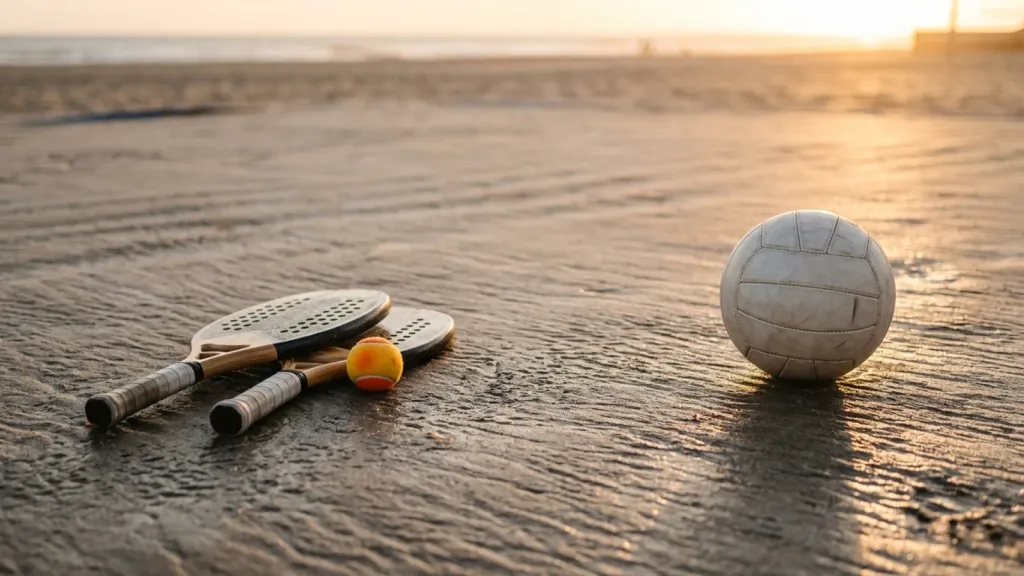
There are three ways to draw pairs, and each solves a different problem: pure random (shuffle and pair up, no criteria at all), strong paired with weak (matches your better players with your weaker ones to even out skill between pairs), and partner rotation (everyone plays with everyone over the course of the day, so no one is stuck with the same partner). There’s no single “best” method — there’s the right method for what you’re organizing.
Pairs are the trickiest format to draw. In a ten-a-side soccer team, one weaker player gets diluted among nine teammates. In a pair, that person is half the team. If the draw puts the two weakest players in your group together, that pair loses every game and nobody has fun — not the losers, not the team crushing them 6-0. That’s why beach volleyball, beach tennis, and partner card games like euchre or bridge night — sports and games that are almost entirely played in pairs — need a thought-out draw method, not a “let’s just see how it goes” approach. The principles are similar to drawing teams in general, but with less room for error, since there’s no full team to absorb the imbalance.
Method 1: Pure random draw
The simplest option: every name goes into a hat, an app, or a shuffled list, and the order they come out forms the pairs — first name with second, third with fourth, and so on.
When to use it: when the group is roughly even in skill, or when the point of the day is purely social with no competitive stakes. At a casual card night among friends who play at similar levels, nobody minds who they land with. The same goes for a pickup beach volleyball session among regulars.
When to avoid it: when the group spans very different skill levels — someone who’s played beach tennis for five years next to someone who picked up a racket this week. A pure random draw has a real chance of putting the two weakest (or two strongest) people together, and the whole event gets lopsided from round one.
If your group is already set and you just need to form pairs quickly, the team randomizer does that shuffling automatically — just set the team size to two players.
Method 2: Strong paired with weak
This method exists specifically to fix what pure random draws break. It works like this:
- Rank everyone in the group from strongest to weakest — even a rough, informal estimate works, no official ranking required.
- Pair the top of the list with the bottom, working inward (the same “snake” logic tournaments use to separate seeded players).
With eight people ranked 1 (strongest) to 8 (weakest), the pairs would look like this:
| Pair | Player A | Player B |
|---|---|---|
| 1 | Rank 1 | Rank 8 |
| 2 | Rank 2 | Rank 7 |
| 3 | Rank 3 | Rank 6 |
| 4 | Rank 4 | Rank 5 |
The result is that every pair carries roughly the same combined strength (each adds up to 9), instead of one pair of stars steamrolling a pair that never wins a set. This is the natural fit for a beach tennis bracket with players of very different levels, or any pair tournament with a prize on the line — where fair competition matters more than surprise.
The downside is the work of ranking people beforehand, plus the risk of getting the ranking wrong (someone who looks weak warming up and then dominates on court). It works best when the organizer has already seen the group play.
Method 3: Partner rotation
In a rotation, nobody plays with the same partner twice — over the course of the day, everyone cycles through as everyone else’s partner. This is the classic bar or club card-night format: instead of fixing two pairs that play each other all afternoon, the four players swap partners every game, and by the end nobody walks away stuck with “that one bad pair” because the pair never stayed the same.
With four players (A, B, C, D), there are three possible rotations, and after three rounds everyone has partnered with everyone once:
- Round 1: A+B vs C+D
- Round 2: A+C vs B+D
- Round 3: A+D vs B+C
For larger groups, the same logic scales: the number of rounds needed for everyone to partner with everyone grows with the group size, and in casual beach volleyball or social beach tennis it’s common to simplify by drawing a new partner every match without worrying about closing the full cycle — the practical effect (nobody stuck with the same partner) already kicks in after two or three swaps.
When to use it: social meetups, group practice, a casual card night among friends — any setting where the point is spending time together, not a final ranking. When to avoid it: when there’s a result that matters — a tournament with a prize, an elimination bracket — because swapping partners every round makes it impossible to compare performance fairly.
Which method fits which situation
| Situation | Recommended method |
|---|---|
| Even skill level, no serious competition | Pure random |
| Tournament or bracket with a prize, uneven skill levels | Strong paired with weak |
| Social meetup, practice, casual card night among friends | Partner rotation |
| Official beach tennis group stage (3–4 pairs per group) | Position draw within the group, per tournament rules |
Odd number of players
When one person doesn’t fit into a pair, three fixes work:
- Rotating trio: one “pair” becomes a trio, and a different person from the trio sits out each game, taking turns resting.
- Waiting line: whoever’s left over joins the next round in place of whoever loses — common at beach courts with a line to play.
- Fixed wildcard: the person left over partners with whoever lost the previous round, forming a new pair each game.
None of the three is “the correct” one — the waiting line works best when there are more people than court space; the rotating trio works better in a closed group where nobody wants to sit out for long.
Frequently asked questions
Is drawing pairs with an app fairer than on paper? Technically, they’re identical — both are random. The app is just faster and avoids the “the folded paper was visible” argument. For large groups or a weekly routine, saving time alone is worth the switch.
Can I mix methods? Yes. It’s common to seed strong-weak in a tournament’s first round and switch to rotation for later rounds, or the reverse — it just depends on what the group values more at that point: fair competition or partner variety.