How Many Players Are on a Futsal Team? Starters, Bench and Substitutions
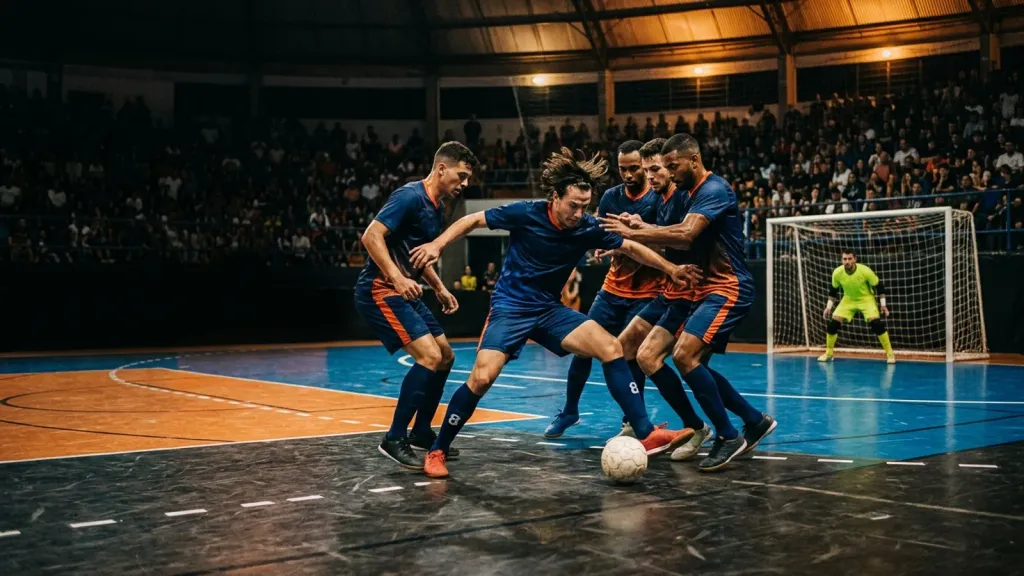
A futsal team plays with 5 players on the court: 4 outfield players and 1 goalkeeper. That’s the standard number for both sides throughout the match — but Law 3 of futsal allows a game to start with as few as 3 players per team, and the match is stopped if a team drops below that number on the court, for example due to send-offs.
Off the court, the numbers are close across the main competitions. Both the CBFS (Brazil’s governing body) and FIFA allow a bench of up to 9 substitutes, for a squad of up to 14 registered players per team. Senior “A” national team friendlies can go even further, with up to 10 substitutes.
The 4 outfield positions
Futsal doesn’t copy outdoor soccer positions. With a small court and a constant pace of play, each role has its own name:
- Goalkeeper — besides defending, takes part in building attacks with their feet, acting almost like an extra outfield player when the team has possession.
- Fixo (defender) — the deepest defender, the reference point for marking and usually the first to organize the team once possession is won back.
- Left and right wing — play the lateral channels, switching between defending and supporting the attack. They’re typically the players who cover the most distance during a match.
- Pivot — plays higher up, with their back to the defender, to receive passes and finish. The rough equivalent of a center forward in outdoor soccer.
These four roles rotate constantly and swap during play — it’s common for a winger to drop into the pivot spot for a few seconds and then move back out. The naming helps organize tactics, but it isn’t a fixed lineup the way outdoor soccer positions are.
How many players fit on the match sheet
| Competition | Starters | Substitutes | Total registered |
|---|---|---|---|
| CBFS (official regulations) | 5 | up to 9 | up to 14 |
| FIFA official competitions | 5 | up to 9 | up to 14 |
| Senior “A” national friendlies | 5 | up to 10 | up to 15 |
The legal minimum for a match to start is 3 players per team, under Law 3 of futsal — but in practice teams almost always take the court with all 5 starters. The same floor applies to keep the match going: if a team drops below 3 players on the court, for example due to send-offs, the referee ends the game.
There’s no requirement to fill the whole bench. A team can take the court with only its 5 starters and no substitutes if it comes to that — rare in competition, but common in friendlies or training sessions.
How the flying substitution works
Player changes in futsal are called “flying substitutions” because they happen with the ball still in play, without stopping the match:
- Unlimited — there’s no cap on how many times a player can go off and come back on in the same match.
- No referee approval needed — unlike outdoor soccer, the referee doesn’t need to authorize the change.
- Through the substitution zone — a marked strip on the sideline next to each team’s bench. The player coming off has to fully leave the court before the substitute steps on.
Entering too early is an infraction and results in a foul against the team. Outside that procedural rule, substitutions are free — which is why high-level teams rotate their entire lineup every 1 or 2 minutes, keeping the pace high without sacrificing physical quality.
That’s a very different substitution logic from other indoor sports. In volleyball, for instance, regular substitutions are capped at six per set and libero changes follow their own referee-approved rules; in futsal, there’s no cap at all and no one needs to approve anything.
The goalkeeper can also switch roles with an outfield player mid-match — becoming a “flying goalkeeper,” a tactic used when a team needs an extra attacker, usually in the closing minutes while trailing.
How many people you need for a pickup futsal game
Because substitutions are unrestricted, a pickup game among friends doesn’t need exactly 10 people (two teams of 5) to work well. Some practical numbers:
- 10 people — two teams of 5, no bench. Everyone plays the whole time, no rotation. Works fine for short games.
- 12 people — two teams of 6, one substitute per side. Enough to rest a tired player for a few minutes without weakening the team.
- 14 to 16 people — two teams of 7 or 8, with a rotating bench. This is the ideal range for an hour-plus session, since unlimited substitutions let you keep the pace high the entire time without anyone sitting out too long.
The one thing to sort out first, as with any sport that has a dedicated goalkeeper role, is deciding who plays in goal before splitting the rest of the group — not everyone is willing to play that position, and an imbalance there tends to decide the score more than the overall skill of the outfield players. If you already know how many people are playing and just need to split the groups, the Squadb team randomizer does that automatically while keeping the sides balanced.
Once the teams are set, the same principles that make any pickup game well organized still apply: an agreed rotation schedule, fair goalkeeper turns, and someone in charge of calling substitutions when the group is large.
Frequently asked questions
Can you play futsal with 4 players per team? Yes. Law 3 of futsal allows a match to start with as few as 3 players per team, so 4 is within the rules. In practice this is rare — teams almost always take the court with all 5 starters — but it can happen due to last-minute injuries or a shortage of available players.
Can the goalkeeper play as an outfield player? Yes. It’s the “flying goalkeeper” tactic, where the team pulls its regular goalkeeper and brings on an extra outfield player, usually to press the opponent in the closing minutes.
What’s the difference between futsal and outdoor soccer substitutions? In futsal, substitutions are unlimited and don’t stop play. In professional outdoor soccer, the number of substitutions is capped and each change requires a stoppage and referee approval.