How Many Players Are on a Volleyball Team? The 6 on Court, the Libero and the Bench
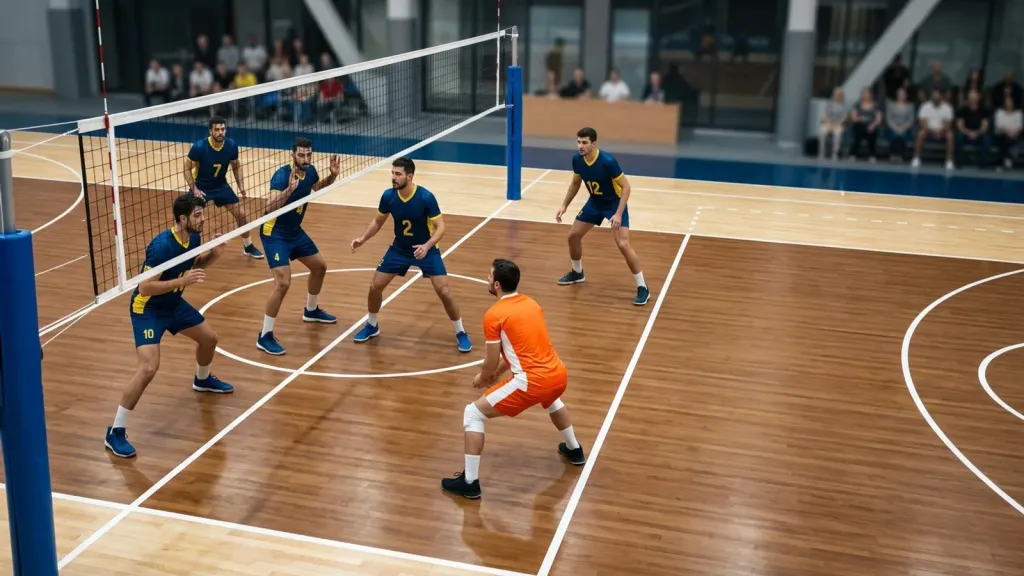
A volleyball team plays with six players on the court at a time, on both sides of the net. That number is fixed and doesn’t change during a match — but it’s not the whole team. An official match sheet can list up to 12 athletes, going up to 14 in FIVB official senior competitions, plus up to two liberos who play under their own set of rules.
If all you needed was the number, you have it: six. The rest — who fills the bench, what the libero can and can’t do, and why players swap positions after every point — is what turns watching a match into actually understanding one.
Court, roster and bench: the three numbers that matter
| Item | Number |
|---|---|
| Players on court per team | 6 |
| Standard roster on the match sheet (general rule) | up to 12 |
| Roster in FIVB official senior competitions | up to 14 |
| Liberos a team may designate | up to 2 (mandatory to have 2 once the roster exceeds 12) |
| Liberos on court at the same time | only 1 |
| Bench (reserves beyond the 6 starters and the liberos) | the rest of the registered roster |
In practice, club and national teams usually fill the sheet with 12 or 14 names: six starters, the acting libero, and the rest split between reserve hitters and the second libero. Amateur leagues and company or campus tournaments rarely require that full count — many run fine with just a bit more than six players, as long as there’s enough cover for an injury.
The 6 positions on court
Volleyball doesn’t have fixed positions the way soccer has a left-back or a striker — each player’s spot on court changes with every rotation. But the tactical roles are well defined:
- Setter — runs the offense, deciding who gets the second touch. Think of it as the team’s playmaker.
- Opposite hitter — usually the main attacking option, lines up across from the setter in the rotation and hits mostly from the right side of the net.
- Outside hitters (2) — attack from the edges of the net and also receive serve; typically the most complete players on both offense and defense.
- Middle blockers (2) — play closer to the center of the net, focused on blocking and quick attacks.
- Libero — a defensive and serve-receive specialist, covered in detail below.
Because mandatory rotation forces everyone to cycle through every position on court, a middle blocker will, at some point in the set, stand in the serving spot, and an outside hitter can end up in the back row. What changes from player to player is the tactical role they carry out in that spot — not the position itself.
The libero isn’t a regular substitute
The libero is the piece that confuses newcomers to volleyball the most, because they add to the roster without counting as a normal substitution. Under the official FIVB rules (2025–2028):
- The libero can only play in the back row — never completing an attack hit from anywhere, on court or in the free zone, if the ball is entirely above the top of the net.
- They cannot serve, block, or attempt to block. It’s a pure defense and reception role.
- Swapping the libero in for a front-line player (and back out) is called a libero replacement and is unlimited — it doesn’t count against the set’s regular substitution limit. The only requirement is that a completed rally must pass between one replacement and the next.
- The libero wears a uniform in a clearly different color from the rest of the team, so referees and fans can spot them instantly.
- A team may register up to two liberos on the sheet, but only one is on court at a time. In FIVB official senior competitions, having two liberos becomes mandatory whenever the roster has more than 12 players.
In short: the libero makes a team stronger at serve-receive and defense without spending a substitution — the trade-off is giving up that player at serve, at the block, and in the attack.
Rotation: why the on-court position changes after every point
Whenever the receiving team wins a rally, it earns the point and the right to serve — and, before the next serve, all six of its players rotate one spot clockwise. Whoever was in position 1 (serving) moves to position 6, whoever was in position 2 moves to position 1, and so on.
This mandatory rotation is why a great hitter also needs to know how to serve and pass: at some point in the set, that player will occupy every one of the six court positions. Rotating out of order is a positional fault and hands the point to the opponent — which is why teams mark the correct rotation order on the bench before every set.
Regular substitutions have a limit too
Aside from libero swaps, each team can make a maximum of 6 substitutions per set. And there’s a rule that locks in the pairing: a starter can leave and come back only once per set, always to the same rotation spot, and can only be replaced again by the same substitute who first came in for them. You can’t swap in a different reserve for that same starter later on.
That’s why top teams manage substitutions carefully — burning them too early in a set can leave a coach with no options for the decisive stretch of a fourth or fifth set.
Indoor volleyball vs. beach volleyball
Worth a quick clarification for anyone who searched “volleyball team” thinking of the beach version: beach volleyball is played with two athletes per side, with no libero and no rotation in the same format — it’s a discipline with its own rulebook, set separately by the FIVB. Everything covered above applies to indoor volleyball, the format played in gyms, schools and major leagues like the NCAA, professional club leagues and international federations.
Frequently asked questions
Can a team keep playing volleyball with fewer than 6 players on court? Not under this format. If a team can’t field six players on court due to injury or ejection and has no way to replace them, the match is declared incomplete and that team loses the set or the match.
How many players sit on the bench? It depends on roster size. With a 12-player roster, 6 sit out (after the 6 starters); with 14, it’s 8 — always keeping in mind that the acting libero is on court, not on the bench.
Does the libero count as one of the 6 players on court? Yes. While playing, the libero takes the spot of a back-row player — the team still has exactly six players on court, one of them just happens to be the libero.
If you’re organizing a volleyball game among friends and need to split the group into two six-player teams, the Squadb team randomizer handles that split automatically, even when the headcount doesn’t divide evenly into 12.