Futsal Positions: Goalkeeper, Fixo, Winger and Pivot Explained
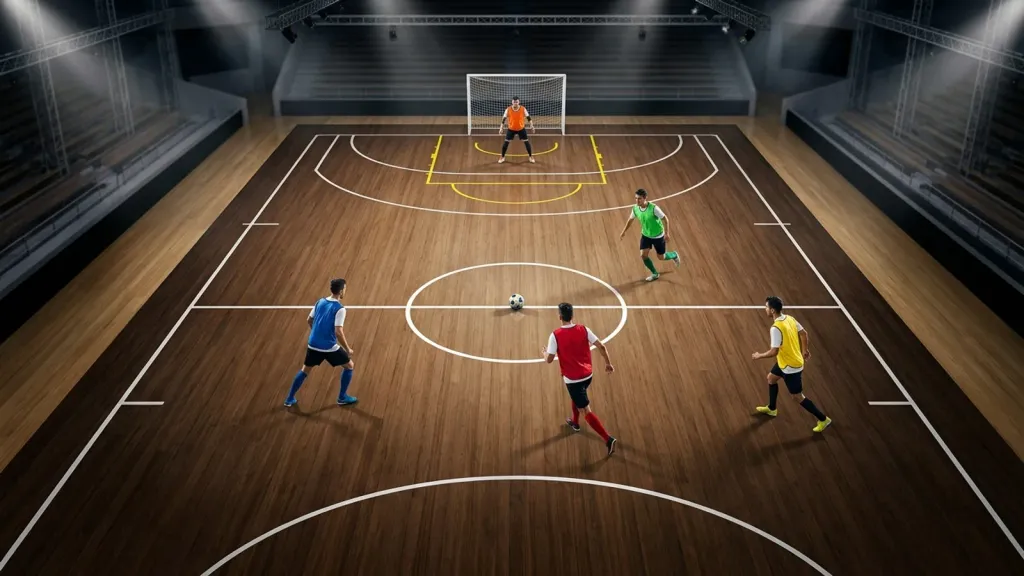
Futsal has four outfield positions plus the goalkeeper: fixo, left winger, right winger, and pivot. If a coach or teammate told you to “play fixo” and you have no idea what that means, here’s the short answer: you sit deepest among the outfield players, right in front of the goalkeeper, organizing the defense and starting the attack once your team wins back the ball. But to play any pickup futsal game with a bit of structure, it helps to understand all four roles — because in practice, everyone rotates through them during the match.
Unlike outdoor soccer, these positions aren’t a fixed lineup. The court is small, the pace is constant, and the four outfield players swap spots several times a minute. The naming exists to organize tactics, not to lock anyone into one spot.
Goalkeeper: the first outfield player
The futsal goalkeeper defends the goal but also builds attacks with their feet like an extra outfield player. FIFA’s Laws of the Game give the goalkeeper freedom to move anywhere on the court and play the ball with their feet without restriction once in the opponent’s half — the limit only applies in their own half, where they can’t hold the ball for more than 4 seconds and can’t receive it back from a teammate unless an opponent has touched it first. In practice, this makes the goalkeeper the first playmaker, similar to a sweeper-keeper in outdoor soccer.
Fixo: the defensive organizer
The fixo is the deepest outfield player, positioned right in front of the goalkeeper. The Portuguese term means “fixed” — the idea of being the anchor at the back, protecting the area and being the first to mark the opposing pivot. Despite sounding purely defensive, the fixo also starts much of the attack, distributing the ball to the wingers as soon as the team regains possession.
Wingers: the engine of the team
The two wingers — left and right — play the lateral corridors of the court, switching between defending and supporting the attack. They’re usually the players who run the most during the match, since they need to push forward and drop back constantly at futsal’s fast pace. A winger with good stamina and a quick pass can break through marking easily, since the court is small and any open space becomes a scoring chance.
Pivot: the attacking reference point
The pivot plays furthest forward, usually with their back to the defender, receiving passes and holding up play until a teammate arrives to finish or until they can turn and shoot themselves. It’s the position equivalent to a center forward in outdoor soccer, but with closer physical contact — in futsal, the pivot often plays “glued” to the opposing defender, fighting for every ball with their body.
Flying goalkeeper: the position that breaks the rule
One of the plays that confuses first-time futsal viewers the most is the “flying goalkeeper” tactic. It’s when a team pulls its regular goalkeeper off the line and puts an extra outfield player in that role — the team essentially plays with five outfield players, while an outfield player often wears the goalkeeper’s jersey and takes over that role, freeing up the original goalkeeper to play furthest forward.
It’s a calculated risk: the team gains an extra attacker, but is exposed to conceding a goal from midcourt into an empty net if possession is lost. Because of that, the flying goalkeeper mostly shows up in two situations: in the closing minutes when a team is losing and needs to gamble everything, or as a planned tactical system (known as “power play”) used by top-level teams to force a numerical advantage.
Formations: how the four positions organize on court
Futsal doesn’t have one mandatory formation — the classic one is the 1-2-1 diamond: the fixo at the back, the two wingers on the sides, and the pivot up front, forming a diamond shape on the court. That’s the system that gives these four positions their names. From there, teams vary depending on the moment of the game:
- 1-2-1 (diamond) — the reference formation, with a clear fixo, two wingers and pivot. Balances defense and attack.
- 2-2 (square) — two players sitting deeper and two further forward, without an isolated fixo. Teams use it to press as a block and build more passing triangles.
- 3-1 — three players in defense and only one further forward. Shows up when a team is ahead on the scoreboard and wants to protect the result, or against an opponent using a flying goalkeeper.
- 4-0 — no player stays fixed at the back; all four outfield players rotate continuously. It’s the most demanding formation physically and tactically, used by teams that prioritize possession and constant rotation.
A single team can move through three or four of these formations within one match, depending on the score and time remaining — position swapping in futsal is just as fluid as the flying substitutions the sport allows.
How to assign positions when splitting up a pickup game
When you’re putting together teams for a pickup futsal game, it helps to use each person’s profile to decide who plays where:
- Pick the goalkeeper first. It’s the most specialized position and the one that most often decides a balanced pickup game — choose whoever genuinely enjoys playing in goal, or rotate if no one has a clear preference.
- Put whoever reads the game best at fixo. They don’t need to be the fastest, just someone who organizes the defense and knows when to push forward with the ball.
- Save the wings for whoever can run the most. It’s the most physically demanding position on the court — better stamina means more output on the flanks.
- Leave the pivot for whoever is comfortable playing with their back to goal. Holding up the ball under pressure and finishing on the turn takes a player with good body control, not necessarily the fastest one.
Since futsal allows unlimited flying substitutions, this assignment doesn’t need to be rigid — you can rotate positions throughout the game, especially with larger groups. If you already have your players lined up and just want to split the teams quickly before deciding who plays where, the Squadb team randomizer does that split automatically while keeping both sides balanced.
Once teams are set by position, the rest of the substitution logic follows the same rules as any futsal match — see how the flying substitution and futsal team size work to round out your game’s organization.
Frequently asked questions
Is there a center-back position in futsal? Not under that name. The equivalent role is the fixo, who plays deepest and organizes the defense, but joins the attack far more often than a center-back would in outdoor soccer.
Can a pivot play fixo during a match? Yes, and it happens constantly. Futsal positions describe each player’s main tactical role, not a fixed lineup — it’s common for a pivot to drop back to help defend and for a fixo to push forward to finish a play.
Which futsal position runs the most? Usually the wingers, since they cover the entire side of the court both defending and attacking, at futsal’s intense pace.