CS2 roles explained: what the IGL, AWPer, entry fragger, lurker, and support actually do
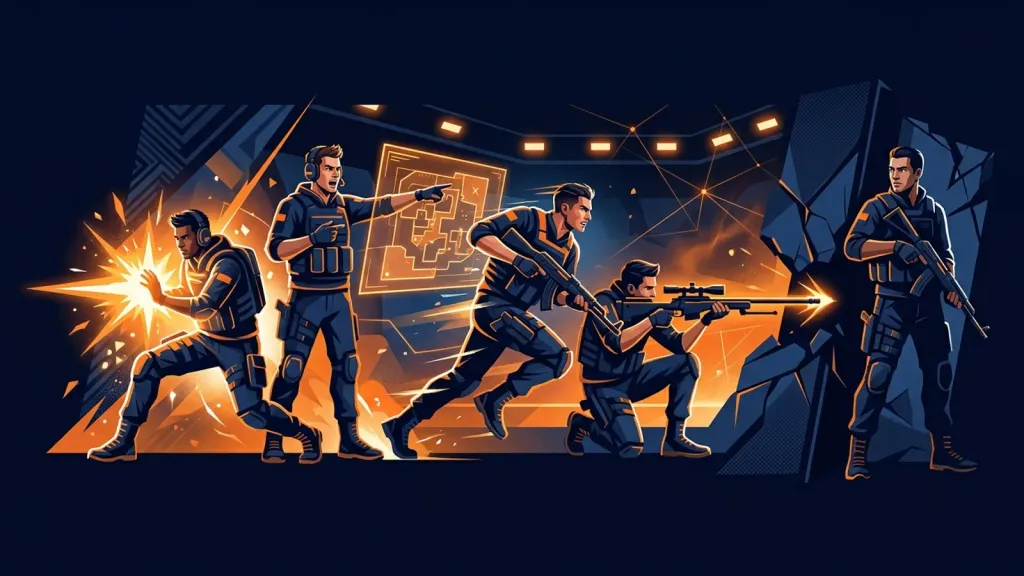
A CS2 team fields five starters, and each one covers a role: IGL, AWPer, entry fragger, lurker, and support. This isn’t a label slapped on after the scoreboard — it’s the job someone does every single round, before any kill happens. The most common mistake in a friend group isn’t aim: it’s everyone fighting over the AWP while nobody wants to hold a bombsite alone while the other four push elsewhere.
The five roles and what each one costs the player
Every role has a specific job in the round — and a price the person doing it pays, whether in risk, personal stats, or freedom to play their own game.
IGL: the one thinking for the team, even at the cost of playing worse
The in-game leader (IGL) calls the strategy before the round starts and adjusts it mid-round based on what the team has learned about the enemy. They decide whether the team eco’s, force-buys, or executes fast on a site, and usually position themselves for information rather than frags — which in practice means the IGL almost always has the worst K/D on the starting roster. That’s not a lack of skill; it’s the role demanding they watch the whole map instead of hunting duels. Someone who enjoys understanding the “why” behind a play more than landing the shot tends to fit here.
AWPer: the one carrying the most expensive gun in the game
The AWP costs $4,750 in CS2’s buy menu — the priciest weapon available — so the entire team’s economy often bends around making sure the AWPer can always afford it. In return, the AWPer holds long sightlines, locks down corridors, and punishes anyone who peeks carelessly with a single shot. It’s the most contested role in friend groups, because it shows up most in the highlight reel, but it also carries the most pressure: losing the AWP on an eco round can cost the whole game.
Entry fragger: the one who enters first — and dies first, by design
The entry fragger is the first to step into the bombsite, the first to take the duel, and, most rounds, the first to die. That’s not a failure — it’s the role working as intended: by forcing the first engagement, they reveal where the enemy is and open space for the rest of the team to trade that death for a numbers advantage. An entry fragger who survives every round is usually playing too slow for the role. Someone willing to risk their own scoreline for the round fits better here than someone chasing the highlight kill.
Support: the one who opens the path without showing up on the scoreboard
The support plays with utility — flashes, smokes, and molotovs — to blind the enemy, cut sightlines, and cover the entry fragger’s push. Their work rarely turns into a kill: a well-thrown flash takes an enemy off the screen for two seconds, and a teammate gets the frag. It’s the most avoided role in friend groups, precisely because personal stats don’t reflect how much it decides the round — but a team with nobody on utility loses entries it should win, simply because no one blinded the dangerous angle.
Lurker: the one playing alone to cut off the enemy team
While four teammates pressure one side of the map, the lurker plays apart, alone, watching for rotations. Their job is to stop the enemy from sending reinforcements to wherever the rest of the team is attacking — whether by holding a passage or by appearing from behind once the opponent has already committed elsewhere. It demands patience and round-timing awareness more than reflexes: the lurker spends most of the round waiting for the right moment, not shooting.
How one role becomes two on a five-friend team
Professional teams sometimes stack two roles on the same player — an IGL who also holds the AWP, or a support who also lurks when the map allows it. On a five-friend team, that’s usually necessity, not choice: there’s rarely enough people for five pure specialists. The most common combo is IGL with support, because both roles already demand thinking about the team before thinking about your own frag. The riskiest combo is IGL with entry fragger, because it means switching between “die first to open information” and “survive to plan the next call” — it works, but it takes an experienced player.
Quick reference: weapon, job, and what each role sacrifices
| Role | Job in the round | What it sacrifices |
|---|---|---|
| IGL | Set and adjust the strategy | Personal stats, frag focus |
| AWPer | Hold long sightlines with the AWP | The team’s economy priority |
| Entry fragger | Open the bombsite first | Their own survival that round |
| Support | Play utility so the team can advance | Showing up on the scoreboard |
| Lurker | Cut rotations alone | Playing near the group, slower pace |
How to split the roles across five friends, step by step
- Ask who already likes lining up long-range shots. They’re the natural AWPer candidate — the role demands consistent aim more than quick reaction.
- Avoid making the AWPer your IGL too, if you can. The two roles compete for the same attention: one needs full focus on the duel, the other full focus on the map.
- Pick the IGL for their interest in strategy, not their aim. The player who rewatches demos most, asks “why did we lose that round” most, and enjoys planning is the right fit — even if they don’t have the best K/D.
- Reserve entry fragger for whoever doesn’t mind dying first. It’s the role that frustrates most anyone who measures their performance purely by the final scoreline.
- Put whoever enjoys utility on support — not whoever’s “left over.” Throwing flashes and smokes well takes repeated lineup practice and timing — better to pick someone with patience to train it than whoever got picked last.
- Leave lurker for whoever plays well alone and doesn’t mind being away from the main action. It’s the loneliest of the five roles, and someone who dislikes making calls without the team nearby usually struggles there.
- Rotate roles between matches, not mid-map. Switching roles mid-session breaks the read the team has already built on the opponent.
If the group already has ten people wanting to set up two CS2 teams for a pickup match, Squadb’s team randomizer splits them into two squads automatically — from there, apply the steps above inside each team to decide who plays what.
FAQ
Do you need one fixed player per role? It’s not a rule, but it’s the most stable starting point. Teams without a support, for example, enter sites uncovered and lose duels they should win.
Can you play without a fixed AWPer? Yes, rotating the rifle to whoever has spare money that round — but teams that swap AWPers every match lose the consistency that comes from repeated practice with the gun.
Which role is easiest for someone new to CS2? Support tends to be the gentlest entry point: the grenades help the team even while the player’s aim is still developing.
If the group also plays Valorant, the same logic of splitting roles by player profile — not by who wants the kill — applies the same way. The guide how to build a Valorant team breaks down that game’s four roles and how to fit them among the same friends.