How to Draft Teams by Position: Goalkeeper, Defense, Midfield, Attack
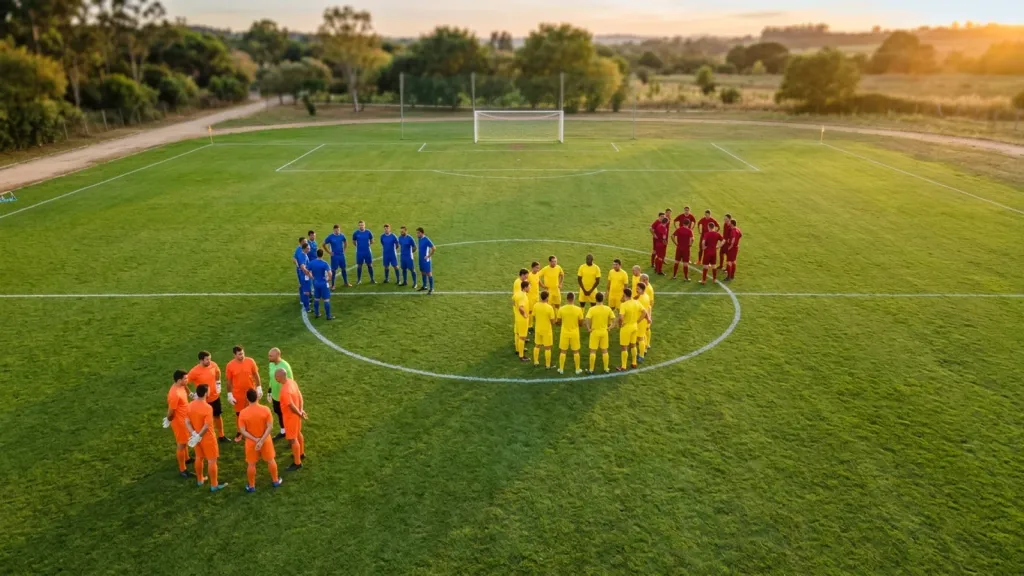
Drafting by position means grouping players — goalkeepers, defenders, midfielders, forwards — and drawing within each group before you assemble the teams. Only after that do the groups get merged. That one detail is what prevents the classic failure of a fully random draw: one team ending up with no goalkeeper while the other has four strikers fighting over the same ball.
Why a fully random draw fails
When you throw every name into one pool and draw without separating by position, the result depends entirely on luck — and with few players per role, luck gets it wrong more often than you’d expect.
A concrete example: 14 players, 2 of them goalkeepers, split into two teams of 7 with a purely random draw. Fix the first goalkeeper on a team; that leaves 13 remaining slots, 6 of which belong to his team. The odds of the second goalkeeper landing on the same team are 6/13 — almost 46%. In other words, in nearly half of random draws with these numbers, one team ends up with two goalkeepers and the other with none.
If there’s only one goalkeeper in the whole group, the problem isn’t probabilistic anymore — it’s guaranteed: one of the two teams will start the match without a real goalkeeper, no matter how many times you redo the draw.
The same logic applies to strikers and defenders. With few players per role, chance concentrates instead of distributing.
The method: stratified draft by position
The technical term is “stratified sampling,” but in practice it’s simple:
- Split the players into position groups. Goalkeepers in one group, defenders in another, midfielders in another, forwards in another. If someone plays more than one position, put them in the group for whichever position they play most that day.
- Draw within each group, not across groups. Shuffle the goalkeepers among themselves, the defenders among themselves, and so on.
- Alternate the assignment between teams, one group at a time. The first goalkeeper drawn goes to Team A, the second to Team B; the first defender drawn goes to Team A, the second to Team B, the third back to Team A, and so on.
- Merge the groups. Each team ends up with its proportional share of every position — no team disappears without a goalkeeper, no team turns into an all-attack squad.
Worked example
A group of 14 players for two teams of 7, with a balanced breakdown:
| Position | Total in the group | Team A | Team B |
|---|---|---|---|
| Goalkeeper | 2 | 1 | 1 |
| Defense | 4 | 2 | 2 |
| Midfield | 4 | 2 | 2 |
| Attack | 4 | 2 | 2 |
Each team ends up with 7 players and the same structure: one goalkeeper, two defenders, two midfielders, two forwards. Who from each position goes to which team is still random draw — only the overall structure stopped being left to chance.
When the group doesn’t split into a round number
In real life, a group of friends rarely shows up with exact numbers that divide cleanly by two. If you have 5 midfielders to split between two teams, someone ends up with 3 and the other with 2 — there’s no way around that.
The fairest way to handle the leftover is:
- Draw for who gets the extra player, instead of deciding by convenience.
- Rotate who gets the leftover from week to week, if it’s a regular group. If Team A got the extra midfielder today, Team B gets the next leftover next week.
- If more than one position has an odd leftover, consider reclassifying a borderline player into a neighboring group (a deep-lying midfielder can join the defense group, for instance) just to make the numbers work — as long as it doesn’t force anyone to play out of position they can’t handle.
The goalkeeper case: the role that needs its own rule
Goalkeeper is where random draft breaks down the most, because there are usually only one or two in the whole group. A few scenarios and how to handle each:
- Two goalkeepers for two teams: the simple case — one per team, drawn between the two to decide who goes where.
- Only one goalkeeper: draw which team keeps them. The other team needs a volunteer from an outfield position, or the two teams can rotate the goalkeeper by half — they play the first half for one team and the second half for the other.
- No declared goalkeeper: ask for a volunteer before the draft, or draw the role among defenders willing to play in goal. Rotate the role between matches so the same person doesn’t always get stuck there.
- Three goalkeepers for two teams: one team gets two. The backup plays outfield (usually defense) or the two rotate by half within that same team.
Minimum viable lineup by position, depending on the format
There’s no governing-body rule about how many players each position needs in a pickup game — that’s up to whoever’s playing. What changes by format is the total team size, and from that you can work out a minimum split that leaves no line empty:
| Format | Full team | Goalkeeper | Defense | Midfield | Attack |
|---|---|---|---|---|---|
| 11-a-side (full pitch) | 11 | 1 | 3–4 | 3–4 | 2–3 |
| 7-a-side | 7 | 1 | 2 | 2–3 | 1–2 |
| Small-sided turf game (6–7-a-side, varies by pitch size) | 6–7 | 1 | 2 | 2 | 1–2 |
These numbers are a starting point, not a fixed rule. A group that always plays with more attackers and fewer defenders can simply agree on a different split — what matters is that both teams end up with the same structure, not that they follow an outside table.
Combining position with skill level
Drafting by position solves the team structure, but not the balance of strength — you can still end up with two goalkeepers of very different skill on opposing teams. After running the stratified draft by position, it’s worth running a second pass by skill level within each group, so the strongest player in each position doesn’t cluster on the same team. The article how to balance soccer teams covers that second step with a tier system.
Ignoring position when building teams is, in fact, one of the most common mistakes organizers make — the article 5 common mistakes when building soccer teams covers this and other recurring problems.
If you already know who plays which position and just need the split itself, the Squadb team randomizer runs the stratified draft automatically, factoring in position and skill level at the same time.
Frequently asked questions
Does drafting by position take longer than a regular draw? A bit more in the setup — you need to group players by position first — but the draw itself is just as fast. The difference shows up in the result, not the time spent.
What if a player is good at two positions? Put them in the group for whichever position the team needs most that day, not necessarily the one they prefer. That helps fill out groups that are short on players.
Is it worth drafting by position for small groups, like 8 players? It’s worth it even more. The smaller the group, the bigger the impact of a single goalkeeper landing on the wrong team — the math of a random draw gets worse, not better, with fewer players.